
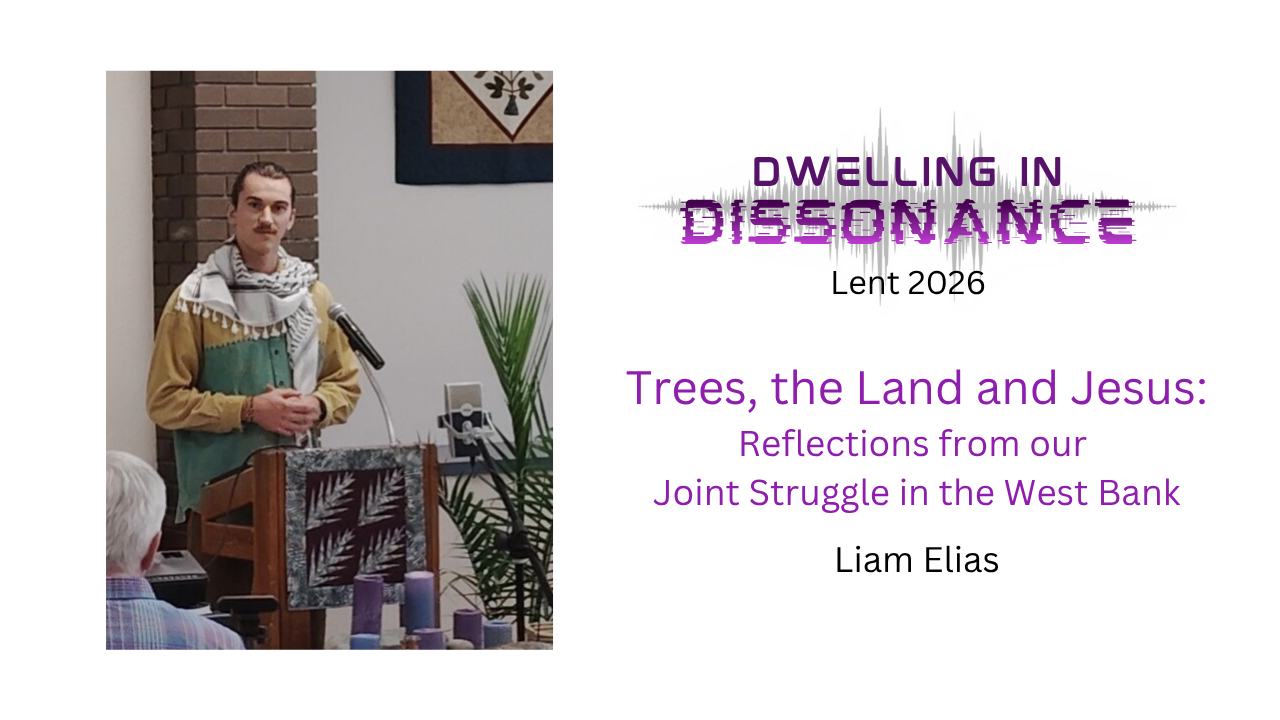
Trees, the Land and Jesus: Stories and Reflections from our Joint Struggle in the West Bank
The article below is an edited version of the sermon Liam shared with Evergreen on March 29, 2026
Easterly Reflections from our Joint Struggle Tour
In February, I joined a delegation of Mennonites traveling to the West Bank. Since returning home, the transition back into daily life hasn’t been easy. But I am deeply grateful for the opportunity to share some of what I experienced, because I feel a responsibility to carry forward the voices and messages of the people we met in Palestine. I remain committed to further learning and to seeking justice wherever I am.
I want to share stories of struggle, challenge, and also glimpses of hope. These are stories that reveal what it means to live, resist, and seek liberation under occupation.
Life Under Occupation
For many Palestinians, daily life is marked by uncertainty, fear, and exhaustion. This comes not only from direct violence, but also from ongoing harassment by settlers and restrictions imposed by the Israeli government. These systems make simple life movements like seeing family, going to school and work intentionally difficult.
At the same time, global conflicts continue to escalate, and innocent people in places like Iran, Sudan, and Ukraine are paying the price. Here in the United States, we also see injustices unfolding: ICE detentions continue, and many in our unhoused communities remain unsupported. These realities are connected in ways that call us to pay attention.
A Soccer Field in Umm al-Khair
One of the most powerful experiences from the trip took place in the South Hebron Hills, in a region called Masafer Yatta. We visited small Bedouin Palestinian villages where pastoral communities face constant pressure from nearby settlements. We heard stories of zionist settlers that contaminate cisterns with gasoline, poison their flocks, graze their sheep on Palestinian pastures, trample livestock with tractors, use tear gas and sound grenades that make your ears bleed, and uproot trees.
In the village of Umm al-Khair, we saw a newly established settlement just steps away from the community. Five bright container homes were installed overnight, flying large Israeli flags. The contrast between the two communities was stark. In the midst of this, the villagers had built something simple yet profound: a small soccer field for their children.
When we arrived, the children were playing, so some of us joined in. Despite language barriers, the game connected us instantly. One boy sent a perfect cross into the air. I jumped to meet it, but just missed. Still, in that moment, it didn’t matter. We were laughing, playing, and sharing joy. Soccer becomes its own language. It’s a reminder of our shared humanity. For a brief time, the weight of everything else faded. It felt like a glimpse of God’s presence among us.
But even this small space of joy was under threat. We learned from a local artist and activist named Eid that settlers had protested the soccer field, claiming it was built without permits. The village is now defending it in court.
The idea that even a children’s soccer field is contested reveals how suffocating these conditions are. Yet building it in the first place is an act of resistance. It is a declaration: we are still here, and we will continue to live. This is what Palestinians call sumud, the steadfast, nonviolent resistance rooted in hope and faith.
During the trip, whenever I felt overwhelmed by anger or frustration, I returned to a simple truth: We are all beloved children of God, each with a place in God’s kingdom.
Learning from Sabeel
We visited Sabeel, a Palestinian Christian organization rooted in liberation theology, where we met with director Omar Haramy. He spoke about what it means to follow “the way” of Jesus. Not as an abstract belief, but as a lived commitment to justice, inclusivity, and nonviolence.
He challenged us, especially as Western Christians, to reflect honestly on how we live. Jesus consistently moved toward those on the margins. He went to be with the poor, the oppressed, the excluded. If we claim to follow him, then we are called to do the same.
In the season of Palm Sunday and Easter, the context of Sabeel comes sharply into focus. The story of Jesus entering Jerusalem is often celebrated with joy, but it also carries a difficult message. Jesus speaks about sacrifice, about letting go of one’s life in order to bear fruit.
This raises hard questions: What does it mean to truly follow that path? What are we willing to give up? And do we have the courage to live differently?
He calls upon us, his followers, not to obsess over our earthly life and that sacrificing it for his sake leads to eternal life. We need to reclaim our religious values and resist our values being hijacked by political agendas.
This was confronting for me. I began to reflect more deeply on my own life. I have benefited from systems shaped by colonialism, and from the privileges I carry.
One of the most striking points Omar made was about the danger of complacency, especially within progressive spaces. It can be easy to believe that we are already “doing enough,” and that belief can prevent us from growing or changing. That realization was uncomfortable but also necessary. I didn’t want to turn away from that discomfort. In fact, it was part of why I went on this trip: to be challenged, to feel again, and to confront the ways I may be complicit through silence or inaction.
The Work of HIRN
Another deeply meaningful experience was visiting the Hebron International Resource Network (HIRN), a grassroots organization supporting Palestinian communities living near settlements. After a long day in Hebron, we gathered in their small office, its walls covered with photos documenting years of work depicting rebuilt schools, homes, playgrounds, water systems, and more.
HIRN operates with a commitment to sumud. Their work is practical and immediate: providing resources, rebuilding structures, supporting farmers, and helping communities remain on their land. Because much of this work is considered “illegal” by occupying authorities, it often happens quietly and at night.
One story stood out. After bulldozers demolished a playground, HIRN volunteers rebuilt it silently overnight. And by morning, it stood again restored without fanfare or recognition. Their lack of bureaucracy allows them to respond quickly and effectively. It’s a model of radical justice not rooted not in words, but in action.
This, too, is sumud, a steadfast commitment to life, even in the face of ongoing destruction.
I want to share some messages from our friends in Palestine:
- We don’t want your sympathy or empty words of ‘solidarity’. Join us in our collective struggle for justice. See that nobody is free until the last of us are liberated.
- Visit us! Come see Palestine, let us host you to show that we are not terrorists.
- We are peaceful people and just want to enjoy life.
In this Easter season, I hope these glimpses of sumud and hope stir inside us a call to follow Jesus’ way of radical love. I believe God hears all of our prayers. So I pray that I and we keep learning, dreaming, and living into a more just and peaceful world for all. We are living in a great turning point in time; the world will not look away from our struggle forever, and there will be a day when ALL of us, including Palestine, are liberated and free.
What can we do?
- The power of prayer
- Listen to the voices of Palestinians and others silenced by mainstream media
- Boycott Divest Sanction
- Challenge governments to promote justice and peace as values
- Find a Palestinian in your neighborhood, get to know them, learn to understand that they are not demons, not angels, they are humans.
- Visit Palestine – the coffee is amazing!
– Liam Elias, April 2026
—
Liam Elias is the Facilities & Land Manager at Camp CAMREC, where he shares, learns, and lives in reciprocity with creation and the Creator. He was raised on the traditional land of the dxʷdəwʔabš (Duwamish) and sduhubš (Snohomish), known today as Bothell, Washington. His formation comes from his church family, Seattle Mennonite, attending public high school, and a bachelor’s education in Environmental Science at Goshen College, where he studied ecology in Northern Indiana, India, and Ecuador. Since graduating, he focuses his energy on relationships both with people and our non-human kin, using his time for experiences such as outdoor youth education, international travel, peace and justice, wildlife conservation, and riparian restoration.
—