
Discipleship v Captivity
Text: Acts 16:16-36
Last Sunday morning I was listening to NPR both before and during my drive to church. And as I’m sure you all know, a news reader will periodically read the headlines between the Sunday puzzle and the interviews with authors and musicians and what have you. Most of the headlines were what you’d expect: the war with Iran and Lebanon, more local political news that I don’t remember. But what I do remember – because I wondering why on earth NPR included it in the headlines – was that that day was the last day of the annual Angola State Penitentiary Rodeo.
Why, with no context, did this bit of news about a prison rodeo make it to NPRs headlines. What is a Penitentiary Rodeo? Who goes to it? Who competes? What’s included? Even before I googled it, I thought, I don’t know about this. The website for this fair-like event, called “The wildest show in the south” includes an illustration of a white cowboy riding a bronco juxtaposed in front of a heavily fenced and barbed-wired brick building with guard turrets on either end.
Both NPR and the glib tag-line, “Wildest show in the south,” and that white cowboy on the bronco, give an impression that this is a fun and fair-like and family-friendly atmosphere. But that notion alone – just on its face – is jarring to me. And when you know, as I’m sure you do as well, that most of the prisons in this country are not primarily populated by white folks, but disproportionately people of color, this smacked to me of minstrelsy.
And then I found a video. It is indeed shocking. To me it looked more like the Roman gladiator stadium than any rodeo that I’d seen. Black men wearing hockey helmets and some foot-ball like padding on their upper bodies close in on a sharp-horned, thousand pound bull, in a kind of game of chicken. The point being to be the last man standing.
In another, a stunt called ‘convict poker’ the men sit around a card table while the bulls are released, the point being to be the last person at the table. Men are being flung through the air, gored, stepped on and all of them are dressed almost comically in black and white striped shirts. A parody of prison garb.
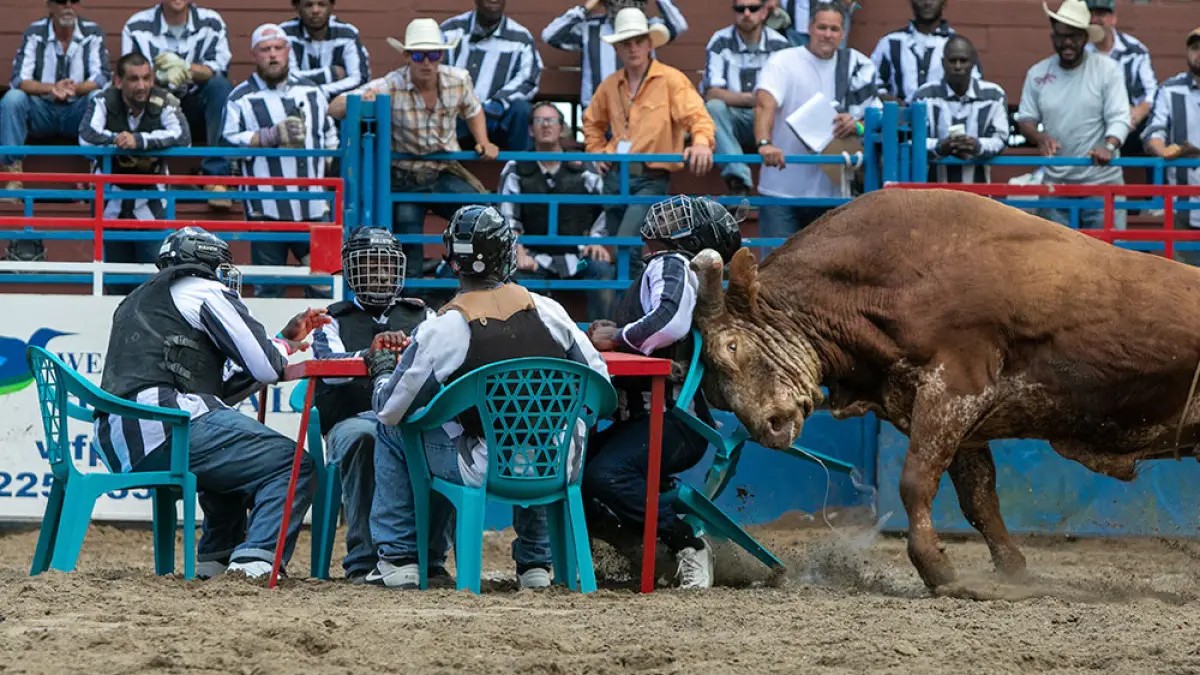
I found it horrifying. I cannot imagine being entertained by this spectacle but clearly people are. I grew up around rodeo people. This is no show of skill. This isn’t a competition for folks who have trained from a young age to be around dangerous animals, to ride horses or rope cattle. This was pure sporting entertainment from the injuring of Black bodies.
Now I had a vague notion of Angola prison being a famous and huge prison in the south. What I learned (because you better believe I dove down this rabbit hole) was that not only is it one of the largest prisons, it, like many prisons in America, grew out of the system of chattel slavery.
I’m sure many of you already know how while the 13th Amendment nominally freed enslaved people, there was a carve-out for those in prison. “Neither slavery nor involuntary servitude, except as a punishment for crime whereof the party shall have been duly convicted, shall exist within the United States, or any place subject to their jurisdiction.”
For that reason, Black people were (and are) picked up for nominal or non-existent crimes and forced into labor. Anecdotately, when speaking to current inmates, they estimate that 80% or more of the people in that maximum security prison are not guilty of the crimes that they are convicted of. Angola transitioned smoothly from being a plantation to being a prison, where the prisoners, even to this day, produce crops like cotton. Picking cotton is one of the first prison jobs that inmates are forced into. They perform or sell hand-made crafts at the rodeo for the small fee or prize money that they can earn.
So why did I take you all on this journey of horror? Because of enslavement and because of prison, both of which feature in our narrative from Acts. As I often do with Acts, I turned to my commentary by Willie James Jennings. He says that enslavement should haunt us like the slave girls haunted Paul. “Such haunting is necessary and of the Spirit,” he says, “as the tormented cries of the enslaved must always encumber the pious actions of the faithful.”
This is a story about discipleship versus captivity. How are Jesus’ disciples called to respond to their own and others’ captivity? Neither the enslavement of the girl – the CEB says ‘woman’ but the Greek word is one used for a female child – nor the capture of Paul can be unentangled from commodification, the exchange of wealth and the exercise of power.
Jennings talks about prison, then as now, being a tool of those with power. People with wealth and power can avoid imprisonment themselves and can deploy it against those without power. The girl – like the inmates in Angola – is being commodified. She is a prophet and she makes a profit for her enslavers, of which there are multiple. To me it brings to mind the way multiple people can own and profit from animals like race horses. She is an animal to them.
When the profit is lost, those same powerful people turned their attention and ire on Paul and Silas. In the same way that they would if he’d injured their profitable thoroughbred. Like the slave girl, Paul too loses his freedom.
I’m going to come back to Paul’s captivity momentarily, and the significant differences between his experience and her. But part of the reason that I’ve been so taken by this story is the girl herself. Did you know that almost half of young women in this era were enslaved in some fashion. I didn’t! Until this week.
Her situation is so intriguing to me and the narrative so opaque about her situation. She annoys Paul his annoyance is turned on her, casting out the spirit which is annoying to him and casting her away. And then we hear nothing else about her. What happened to her??? I have so many questions.
Some scholars think that he freed her of a demon and that’s celebrated. But the spirit wasn’t evil. If anything it was neutral to good. It was proclaiming Paul’s message of the gospel. And even if it was a demon, wouldn’t removing her gift have made things much worse for her? In a culture where so many women were enslave, wouldn’t that profitable spirit be the only thing that prevented her from being trafficked into much worse forms of servitude? Enslavement in which her body was used and abused and abandoned?
How can Paul – a disciple of Jesus – have done this so callously discarded such a vulnerable person?
What I want to think happened is what Acts scholar Ivoni Richter Reimer (a pastor, theologian from Brazil) suggests as a possibility. (But not a given!) She says that because all of this is described as happening on the way to a place of prayer – in her view a Jewish gathering place – Paul’s annoyed release of the girl from her spirit may have meant freeing her into the Jewish community of which Lydia was a part.
Apparently there is evidence in the historical record that the Jewish community in Philippi had bought the freedom of other slaves. Add to that that when Paul freed her from the prophetic spirit, he now legally owed her enslavers money. (Richter Reimer, Women in the Acts of the Apostles).
I speculate that this is in part what leads to the problematic accusation against him – and the sole reason given for his imprisonment – that he’s a Jew and therefore a troublemaker. It would indeed be troublesome for the wealthy of the city to be losing their slaves to Jewish disciples who are buying their freedom.
Regardless, whether Paul is acting out of intention to liberate – even if that was motivated by his annoyance – or whether this is a thoughtless act of self-preservation that leads to greater suffering, this is an opportunity to examine the call to discipleship. One of the Bible commenters that I follow says that when Biblical characters don’t act the way they should, that’s an opportunity for us to do what they should have done in the first place.
We all know that Paul is not perfect. But I’ll give him this: When he does end up in prison his experience there is an example we could follow. Unlike the girl, and unlike all the inmates in Angola, Paul’s sojourn in prison is somewhat out of choice. Paul has a great deal of privilege that allows him to navigate the world in a way that the prophet girl never will.
Paul is a Roman citizen. He could have deployed this fact immediately when he was arrested and accused. He has the same status and situation as his accusers. He’s not just a Jewish troublemaker. Somehow, Paul’s discipleship seems to make him a bit fearless. He goes to prison not caring what will happen to his body. He stays in prison after the earthquake instead of escape.
And he uses that opportunity not only to minister to the guard, but to expose the injustice of the system. If he had invoked his Roman-ness immediately, if he had just escaped in the middle of the night, that would not have brought attention to the captors and oppressors. By staying, by being public, he necessarily evokes a public act of contrition and acknowledgment. There is an assumption that Jews cannot be Romans and vice versa and Paul exposes not only the untruth of that but the inequity in how people of those identities are treated.
While spending time with this story about enslavement and imprisonment this week I learned about the Etty Hillesum, a Dutch Jewish woman who, between 1941 and 1943, documented her war-time experiences in a series of journal entries. She was in her late twenties. She was something like Paul, not only in her Jewishness, but in her fearlessness. Unlike many of her compatriots, she refused to hide or be cowed.
Hillesum talked about being a sanctuary for the divine and the need to protect that spark even thought it created a risk for her physical body. She wrote from Westerbork, a way-station for prisoners on their way to Auschwitz, ”At night, as I lay in the camp on my plank bed, I was sometimes filled with an infinite tenderness and I prayed, ‘Let me be the thinking heart of these barracks.’ That is what I want to be. The thinking heart of a whole concentration camp.” (source)
She was eventually captured and like so many millions was murdered in Auschwitz.
I used to use my non-citizenship in the US as an excuse not to participate in risky civil disobedience-type actions. Not to engage in public protest. I no longer have that excuse and I’ve started to think about how I’m called. If I have any take-aways from this narrative about enslavement and imprisonment it is that indeed we are, each of us, a sanctuary for the Divine.
The prophetic girl was a sanctuary for the Divine. Paul and Silas were a sanctuary for the Divine. Etty Hillesum, the inmates at Angola, each of you. God dwells there and God’s desire is for liberation. We should be horrified by the way human bodies are commodified and violated and abused. We should be horrified that the image of God is being defiled.
And when I’m most honest with myself, I can understand that my discipleship and membership in the Reign of God calls me also to do what I can with this human body to bring liberation to others. Even if sometimes it is because I am so haunted by God’s children that I act from frustration or annoyance. But even better when I can take courage and act from conviction.
May God bless me and all of us with the determination to proclaim and enact liberation.
–