
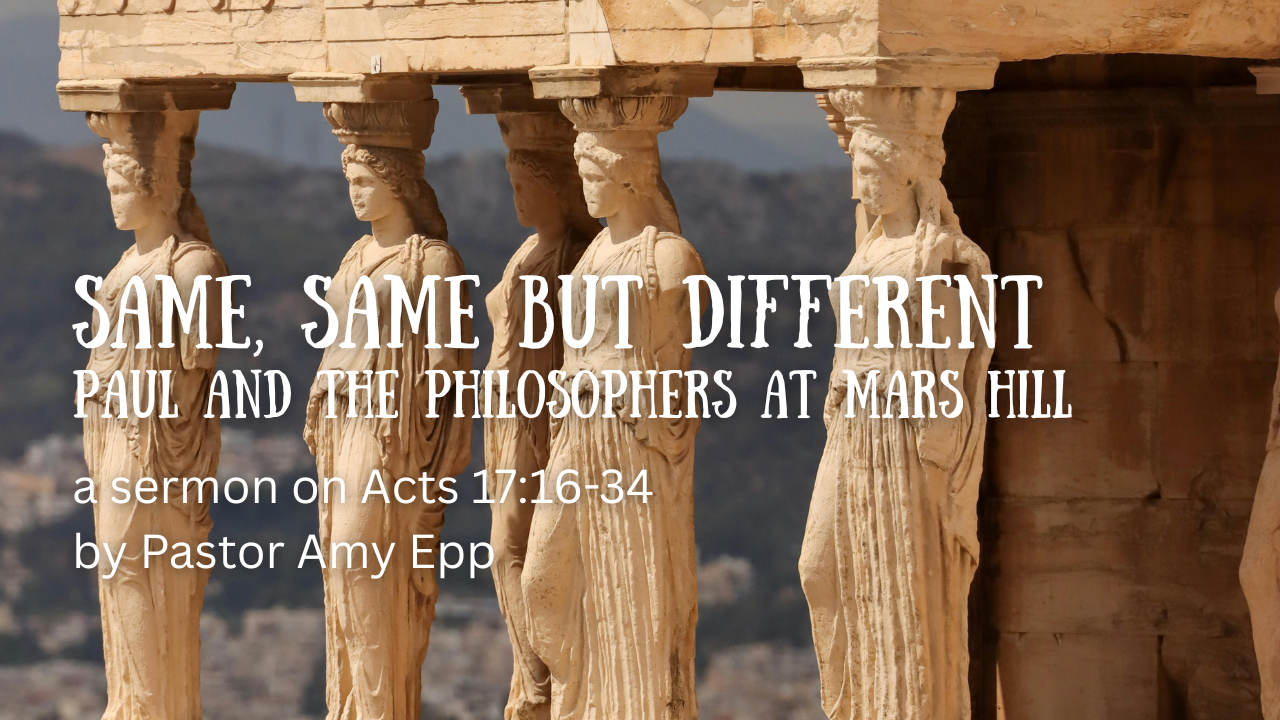
Same, Same but Different
Text: Acts 17:16-34
Several years ago there was a special delegate session of MCUSA in Kansas city. This was after we’d had to skip an assembly because of Covid so there hadn’t been delegate opportunities. And this was the session at which we discerned the future for the Resolution on Repentance and Transformation. You may remember that this was the resolution that decided whether we would repent of excluding LGBTQ+ people from being members and leaders in our congregations. There were other things on the agenda but this dominated for sure.
I was a first time delegate because I was excited to be a voice of support for transformation. And I was at a delegate table where that was not the case for everyone there. I would say that the majority of us, including a gay man and another woman who, like me, was a pastor at a queer-friendly congregation, shared my firm position that we are called to inclusion. But there was a pastor who described his congregation as ‘purple’ and himself was struggling to discern his theological place. And a young man who was his congregation’s youth representative and spent most of the time avidly listening and saying very little.
And then there was Agnes (this isn’t her real name, I don’t think, but it’s the one I’m going to use). Agnes was a woman in her eighties. She was (is?) and artist and shared postcards of her art with everyone at the table. She loved Jesus and her church. She volunteered at the foodbank. She taught Sunday school. Agnes was also deeply distressed about the direction people like me were taking the church.
I loved Agnes. And I thought of her as I was considering the way Paul engaged with a culture that was deeply distressing to him. I suspect that Agnes may have thought that our church was moving – and has since moved – in the direction of idolatry. But she was so loving and kind. She was a little on her own at our table but she was looking for opportunities to connect and find common ground. Together we acknowledged that we love and seek to follow Jesus.
Paul was in Athens on his own. He’d left his buddies Silas and Timothy back in Beroea to do this little side-quest. And while he seemed to be stirring things up back there, here in Athens he was kind of like Agnes. Or she was like him.
Here’s what I mean: Paul’s first instinct when encountering people who think so differently from himself was to consider the things that they value in common. To find points of similarity. He showed knowledge of Greek writers and appreciation for the way they think align. And then there was a point where he named the difference. The thing that makes the way of God unique and (to him) compelling.
Paul was a fish out of water in Athens. Not only was he on his own, he was surrounded by idols – statues and images that were anathema to his Jewish sensibilities – but by a culture of academics and philosophers and debaters. I understand that even though we think of the marble statues of Athens to be very austere – cold and white and hard – that in fact in their own time there were painted bright colors and there may have been fabric draped around. And I imagine that might have been a little overwhelming as well. That’s speculation on my part.
I understand that Tarsus, Paul’s hometown, was a kind of college town. There was some Greek influence and academic culture. But it was a backwater compared to Athens, which is famous for its philosophers and great thinkers and poets who even today are considered influential to Western thought. All the more in its day, when the philosophers and great thinkers would gather in the town center to argue and debate and share ideas.
A note about that town center: The name “Mars Hill” has a bit of a reputation here in Seattle because of its association with the mega church and scandal. In ancient Greece it was a place of robust debate and cultural exchange. The Greek name for the space was the Areopagus, the plaza of Ares. Ares was the god of war and therefore Mars is the Roman equivalent. Thus we get to Mars Hill. Paul entered into an interfaith dialogue on Mars Hill.
The Greeks there called him – variously translated – a babbler, an amateur. Literally the Greek word is a ‘seedpicker’. He’s picking and choosing from the common jargon and ideas and language of the philosophers but maybe not very impressively. When they hear him talk about Jesus and Anastasis (Greek for resurrection) they just think he must be talking about another deity whose name is Anastasis. Like we would name someone Anastasia today.
But they’re still curious. In part because he started his babbling with praise and respect for the culture and ideas that he saw around him. The King James Bible calls them superstitious but Paul truly means religious. Faithful. He understands something about zealous religiosity. He can relate! So he says, I see there’s this inscription to an unknown God. Let me tell you about the God of Creation.
They may consider him a weirdo and an amateur, but these are people who like ideas. I like to think that he’s learning from them as they learn from him. When he says things like, “You’re own poets say…” Maybe he’s been hearing them quote from Artus or Xeno’s work about being the offspring of Divine.
When he hears this, he can say, yes! I understand that I believe something like that. Let me tell you about what it means to be children of the God. Let me tell you about being born of and existing within this God. We’re kind of the same, you and me.
There does come a point at which, as much as he reaches across the cultural and religious divide, Paul claims the uniqueness of faith in Christ. We are the same and we are also different. You’re invited to join me.
This week I learned about a member of Iglesia Vida Nueva named Florencio Bautista who is originally from Oaxaca in Mexico. He is feeling called to return there to his hometown to plant a church. He’s being supported by Pastor Misael and the congregation but he’s seeking the affirmation and support of PNMC and possibly credentialing to further his ministry and mission.
A few months ago when he went back to Oaxaca on vacation, already he was starting to reach out to people in the community. Now, according to Pastor Misael, there are 15 households ready to welcome him as a church planter. He has a house there and he’s imagining meeting on the porch.
I find this story astonishing in the same way I find the stories about Paul astonishing and almost unimaginable. To have a few days in a place and for the first impulse to be the reach out in conversation, sharing ideas, building relationships. I know that there are people whose brains operate this way but mine is not one of them. At least not in the build-a-church way.
Paul proclaims resurrection. He’s clear this time: not another god in the Pantheon but the power of God over life itself. The clarity of his declaration is not for everyone. In fact because he’s literally talking about corpses being raised to life, some people are kind of grossed out and mock him. But again, some are curious and Damaris and Dionysis become followers.
I think this is Paul at his best. He’s curious. He’s finding ways that he can reach across difference to commonly held ideas. He engages in dialogue. In some ways – for me at least – that can be easier with people who are non-Christian than who are Christian in a different way than I like or believe is right. I could probably find more in common and be more invested in a conversation with a Muslim neighbor than with a fundamentalist Christian.
That’s why it feels important to me to remember Agnes. Or even brother Florencio. Those folks have a different way of expressing and understanding faith in Jesus. I know in Agnes’ case that particularly expressed itself in the way she understood the place of our queer kin in the church. We disagreed. But she was a model for loving engagement at the table.
And Paul is not pushy. As few people follow him and he doesn’t overstay his welcome. He doesn’t harang or lecture those who do not. He found common ground where he could and where he could not he moved on. I was reminded that the work of invitation and change is not an all-or-nothing proposition. God worked in the hearts and minds of Damaris and Dionysis and the rest of the Areopagites learned something about Paul’s Jewish/Christian faith and philosophy and he learned something about theirs.
I hope I can be as open hearted and also as firm in my own cross-cultural and interfaith dialogues, whether that’s with other Christians and Mennonites or with folks whose faith traditions are very different from my own. And may we all experience God at work in our conversations and relationships.
—