
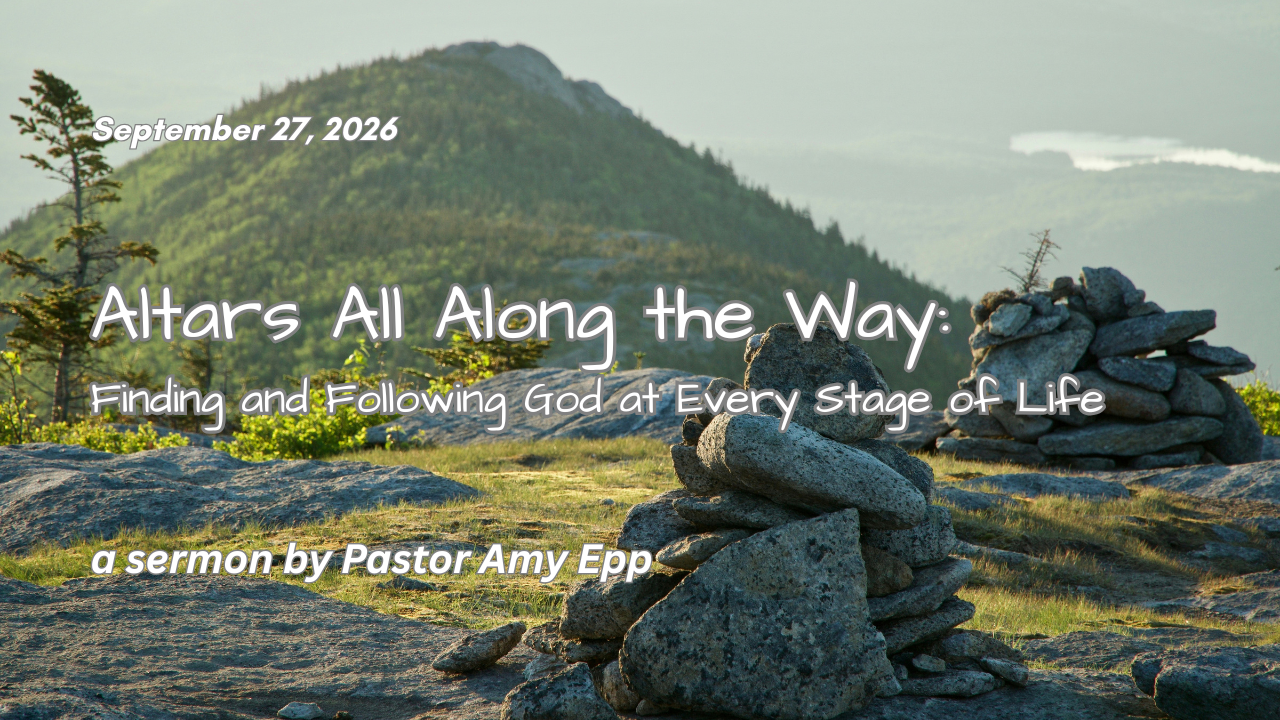
Altars All Along the Way: Finding and Following God at Every Stage of Life
Friends it was my birthday yesterday. I turned 49. This past month or so I have been thinking about how I will spend the last year of my 40s and make the transition to a new decade. I’m looking forward to this year with hope and optimism in a way that as I turned the page into 40 I wasn’t feeling. Maybe I’ve accepted and fully internalized that I am aging. That I’m entering my crone era.
So it may not surprise you that as I was reading this story about Abram – not yet Abraham; we haven’t gotten there yet! – what I noticed was that we get to learn his age. Abram is 75 years old! Do you know who else is 75 years old? My dad! So I immediately imagine a man of my father’s years.
I know that 75 looks different for everyone, but let me tell you about my beloved father: He is the “orchard manager” for a local heritage farm/museum as well as tending his own large garden and landscaped property. He spent the last year teaching a creative writing class at the Mennonite High School. He creates hand-turned and hand-crafted bowls and boxes and benches and all manner of other wooden items. He preaches at least once a month at his lay-led church. He makes wine and, along with my mom, preserves and prepares the many things they grow. I think he still refs soccer and basketball games. And on top of all of this, he somehow manages to read at least a book a week. Apparently this is what retirement looks like.
So when I picture 75-year-old Abram, I don’t necessarily picture a person who is wizened and decrepit. In fact, his relatives (we learn in the previous chapter) all seem to live to 200 or more. So perhaps Abram is, like me, more in his middle years.
But nor do I imagine a person in the bloom of youth. 75 is still a lot of life. This is a man who has already uprooted once from his birthplace. He has married. He has grown a household and holdings of animals and wealth. He has also learned, and presumably come to terms with, the fact that he and his spouse cannot bear children. He has experienced loss. In the chapter before this we also learn that Abram’s brother has died.
And this is the moment when God makes God’s presence known to Abram. A middle-to elder-aged man who is barren and grieving the loss of a brother. Why him? Why then? It’s weird timing.
I think one of the reasons that it feels weird is that the longer I live into my adulthood the more I realize how long adulthood lasts. Childhood and youth go by so quickly in comparison and maybe because they contain so much growth and so many transitions, we – in the church especially – have many opportunities to mark those transitions and that growth: infant dedications, bibles for new readers (don’t actually know if we do that here), graduation ceremonies and quilts. And in youth and young adulthood are also often the time for baptism and marriage – although obviously those can happen at any time.
We don’t really have anything built into the rhythms of our church life for the kinds of transitions that are part of adulthood: living on your own for the first time or buying a home, finding the job, learning something new about yourself as you age, releasing an unhealthy relationship (marriage or otherwise), becoming an empty nester, entering a new decade of life!
My friend Joel, observed the same thing. In the introduction to a workshop he led at MennoCon a year or two ago he said,
After years of witnessing the goodness of [ritual practices with youth], it became evident that 1) life transitions don’t end after high school 2) there are, in fact, an abundance of transitions adults undergo 3) these are some of the most formative, challenging, and potentially Spirit-infused times in people’s lives 4) The church community doesn’t provide much space for reflection and ritual around adulthood transitions beyond weddings and funerals.
During a very fruitful sabbatical and with the help of a small grant, he created a curriculum for an intergenerational small-group opportunity he simply called “Transitions.” He says,
Two of the things congregations already do well are fostering intergenerational community, and practicing meaning-making rituals. This process of naming and honoring adulthood transitions builds on these strengths by gathering together an age-diverse small group of adults to reflect broadly on life transitions and then in depth on one particular transition each member is undergoing.
So as far as I know, even now, Columbus Mennonite Church convenes a small group of 8-10 adults “from 18-100” each year with Pastor Joel to begin with a mini-retreat, meet for six weeks or so in the Sunday school hour and conclude with an evening gathering and worship.
(If this seems like something you might be interested in, please reach out to me. I would be interested in facilitating a group like this – maybe in the new year.)
Pastor Joel is doing something with his congregation that is based in biblical stories like this experience of Abram’s. Abram has experienced a loss. He has also had a profound experience of calling from a God who is entirely new to him. He has uprooted and made a new life for himself because of that call.
As Abram and Sarai and Lot land in what they recognize as a sacred place, a new life, they build an altar. An altar is one kind of ritual, a physical marker of a sacred experience. The building of the altar is a ritual in itself and the place then becomes the reminder to offer thanksgiving, prayer and praise.
But Abram doesn’t make just one altar. He goes along making and breaking camp. Building and rebuilding. Transition after transition along the way and he builds more altars (or at least one more) on the way.
This week also marked the 3rd anniversary of my time with Evergreen. I feel grateful that pastoral callings do have ‘altars’ along the way. Ordination and installations when the ministry begins. I’ve never experienced this in non-pastoral positions. When I worked as a hairdresser, I just got to it and started booking clients.
Because this year feels like the eve of a transition to me, I didn’t want to just let it go by without intention. I was this year to be an ‘altar’ on the way. So with the help of my spiritual director, I planned a short retreat for the beginning of October to reflect on my personal goals and vision for the next part of my life and on my time as your pastor.
I trust and hope that together we will also be moving toward a joint pastoral/congregational evaluation sometime in the next year. I am trying to notice and mark and give thanks for the ways that God has blessed me and to listen carefully for what God is calling me to, and what God may be calling us to together.
If the story of Abram and Sarai teaches us anything it’s that God does not stop speaking to us just because we are aging. God doesn’t stop calling us to new things when we hit a certain mile-stone age, in fact those mile-stones may be just the time when God is looking for an opening, challenging us to look in a new direction.
Our responsibility is to stop, to notice, to create space to see and hear God and mark that spot in time and space in some way. In other words, to build an altar. The altars we build will deepen our understanding of God’s presence all along the way and they’ll deepen our ability to see where God is calling us to next.
I love dedicating babies and baptizing youth. I love wrapping young people in the quilts that we make for them. It is an honor and a privilege to officiate at weddings and at funerals. But I would be so tickled to bless someone as they start a change of careers or go back to school. I would love to celebrate officially being cancer free or graduating from therapy. Releasing or reuniting significant relationships. Paying off a mortgage (or taking on a mortgage) or getting out of debt! Retirement!
These are so many more are a part of our lives and although we do recognize and even have parties for some of them. We don’t necessarily honor them in the church. I want you to know that I at least am down to make altars all along the way. God is there in all of it and the church should be too. Let us listen for God together.