
The Law of Love: Following the 10 Commandments Toward Connection and Liberation
Text: Exodus 19:3b-8; 20:1-17
A little over a week ago our family went to curriculum night. Following our kid’s schedule, we went from class to class, staying in each for about 10 minutes and hearing about what the students were learning and about the teachers’ methods and practices with their classes. It was great! I hadn’t been in the school before and I got a real feel for what a day-in-the-life might be like.
I noticed in at least one class, the teacher had posted the “classroom agreement” on a flip chart paper on the wall. Among other science-related facts and scientific method and instructions for the work they do together. The classroom agreement wasn’t about what the class would be learning but about how they would be a community of learners together.
That classroom agreement included things like listening without interrupting while other people are talking. no name calling or shouting. When I looked up other examples of these kinds of thing online, I found an image of a poster with the title prompt, “What should kids in this class be doing to make sure it feels safe and runs smoothly?” And underneath were a dozen sticky note suggestions from students themselves.
I had never thought about that particular question in that exact way before, but I have also developed these kinds of agreements with young people. Particularly at the beginning of a Sunday school season, or as we would prepare to depart on a trip together. It was important to me that we would be taking care of each other, that we would be able to trust in that caring spirit.
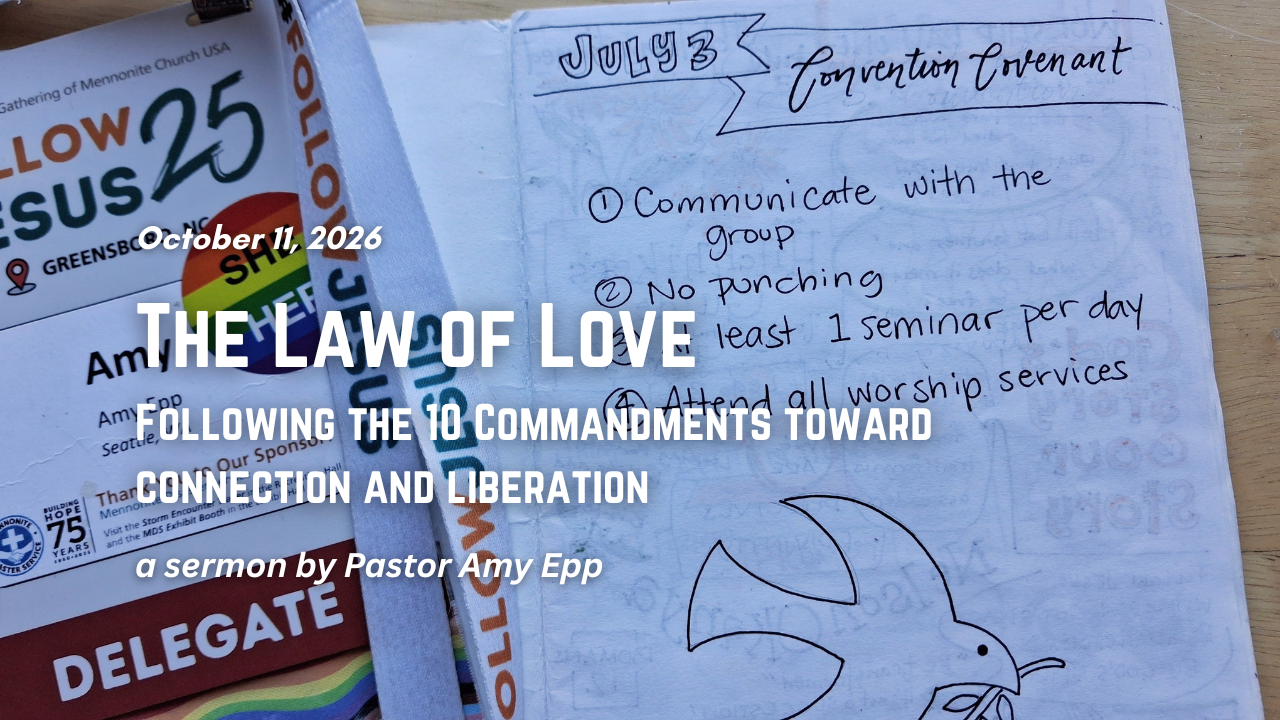
And like the example, I would start with youth suggestions and input, often with a degree of eye-rolling and foot-dragging and questions about why we needed to do this because we already know how to act. And then someone would say, we can just write, be respectful because that’s what it all comes down to. And I would respond, yes, but let’s brainstorm some specific examples of what that means. And finally we would develop a covenant for our community.
(See the image above for an example of an agreement I made with my youth group several years ago while on a convention trip.)
The ten commandments are just that. They are a covenant for a community of people that is about keeping people safe and helping it run smoothly. It is all about relational trust and care. But unlike the classroom agreement, or even (at least explicitly) the youth group covenant whose focuses are primarily or solely on the human relationships with each other, the decalogue is also about the community’s relationship with God.
It may seem – and I will admit, it mostly is – very one sided. God was not asking the Hebrew people for a brainstorm. There are no sticky notes involved. But God did invite a response. Through Moses, God re-tells the way God has brought the people up out of Egypt as if on eagles wings (aside: such a beautiful image of strength and tenderness, especially if you follow any live-action eagle cams of eagle parents.) Then God says,
“if you…stay true to my covenant, you will be my most precious possession out of all the peoples, since the whole earth belongs to me. 6 You will be a kingdom of priests for me and a holy nation…
The people respond: “Everything that the Lord has said we will do.” This is before Moses received the tables. They haven’t even heard the expectations yet! Their response is one of having experienced liberation and out of deep gratitude.
My former generations of youth thought they could summarize our covenant; boil it down to ‘respect’ or ‘love each other.’ And while I didn’t let them get away with that, they were kind of on to something. Because you know who else summed up the law and boiled it down to two essential commandments? Jesus.
In Mark 12:29-31 Jesus answers a question about the most important commandment and he answers:
29 “The most important one,” answered Jesus, “is this: ‘Hear, O Israel: The Lord our God, the Lord is one.[e] 30 Love the Lord your God with all your heart and with all your soul and with all your mind and with all your strength.’[f] 31 The second is this: ‘Love your neighbor as yourself.’[g] There is no commandment greater than these.”
There you go: Love God. Love your neighbor.
Jesus is quoting the decalogue in the first instance, that phrase “Hear, O, Israel” is often known as the shema because of the Hebrew word for hear/listen. The second comes from Deuteronomy, but if you look at the 10 commandments you can kind of see that they do more or less break down in that way: the first half about how we maintain our relationship with the Divine and the second about how we maintain our relationships in community, with our neighbors.
Jesus summed it up, but God has fleshed out a few more of the details. Let’s look again at the ‘Love God’ part of the law:
- Have no other God’s before me
- Do not make idols for yourself
- Take the name of God seriously
- Honor the sabbath day
It feels significant to me that although these instruction are indeed about a relationship with God, the also have communal – and economic – implications. These are laws not just of love, they are laws of liberation that speak to the people’s very recent experience of enslavement in an oppressive system that exploited their labor.
What I mean is this: When we say that we honor God’s commandments along, that means that any king or president or pharaoh cannot command our behavior or time or labor. Similarly, to commit to refraining from idolatry, we are making a commitment to not put something – anything – else a position that supplants God. There are a lot of authorities that compete for our attention. We talked about this when we were reading and studying Christian Nationalism. The nation is not a god but many people treat it as such.
The same impulse to make a nation a religion and to confuse leaders with gods is the impulse to then make declarations in God’s name. We tend to think of ‘taking God’s name in vain’ to mean we shouldn’t curse or use the name of God lightly – OMG should mean “O my goodness.” I don’t think that’s a bad impulse. But there are much more harmful ways to use the name of God, when it’s used to justify violence or injustice or harm against people who are God’s own children.
Finally, the honoring of the sabbath is possibly the most liberating of all. While it is about a pause to worship and return again to the Creator in a regular rhythm. It is also about ceasing to produce. From a system in which these people were expected never to cease work, in a constant church for someone else’s consumption, now there is a commandment to stop. Opt out. People all ages and all genders, every status and every nationality. Even animals! Do not make your identity your work. Your identity is in God.
It is also in community. That’s where the other half of the law of love resides. All of these laws are about maintaining trust and fidelity in community: Respect the elder generation and remember that you come from somewhere and there is wisdom in years. Refrain from violence. Keep promises and be faithful in your intimate relationships.
Don’t covet!. This one is actually also probably economic. The prophets talk about the wealthy coveting fields and seizing them because the wealthy elite are devising ways to take even more for themselves and turning poor farmers into sharecroppers or depriving the workers of their only livelihoods
Any of these laws – and some more than others – when broken erode the threads that hold together community. When they are followed, they build trust and care and strengthen the bonds of relationship.
Mennonites do not tend to be very legalistic. At least not top-down, although our historical practice of banning people and splitting off from each other doesn’t actually speak very well for us. We do have shared understandings however. In fact, the document that guide pastoral leadership expectation is literally call “A Shared Understanding of Ministerial Leadership.” It contains some guideposts for pastors around how we think about power and relationship and ethical behavior.
We also have a relatively new resource to guide our churches in ways that lead into healthy relationships and away from misconduct and abuse. It is called the “Prevention and Accountability Resource” (because why be creative when you can be descriptive?)
A lot of it is for pastors and leaders, to prevent and respond to misconduct and to protect children and other vulnerable people. But It also has a whole section of recommendations for how to build and maintain healthy communities. When a whole community is healthy, its most vulnerable members are more likely to be safe and cared for and loved.
One of those recommendations is for congregations to have a covenant. Described like this:
A behavioral or community covenant is an agreed upon list of practices that congregants agree to live out in their relationships with each other…The practices lead people toward healthy ways of relating in community and help to put community values into practice in congregational life. This covenant may also include processes for addressing violations of the covenant. (p 21)
The covenant may also include a conflict resolution process and a grievance process – both of which are also recommendations in this resource. There is an impulse in many communities to think, like my youth groups, we know how we’re supposed to act. And we do! But every time I think about this resource it makes me wonder what an Evergreen community covenant would look like!
We are invited to live by the law of love. The law of liberation that Jesus summed up as loving God with all of our heart and soul and mind, and loving our neighbor as ourself. But God knows (literally!) that’s hard and offered a few more details for the community of followers about what that might mean. We are called to continue to interpret what God’s law of love means for us in our relationships – with God, with community and in the world. May the Spirit bless our discernment as we do so.