
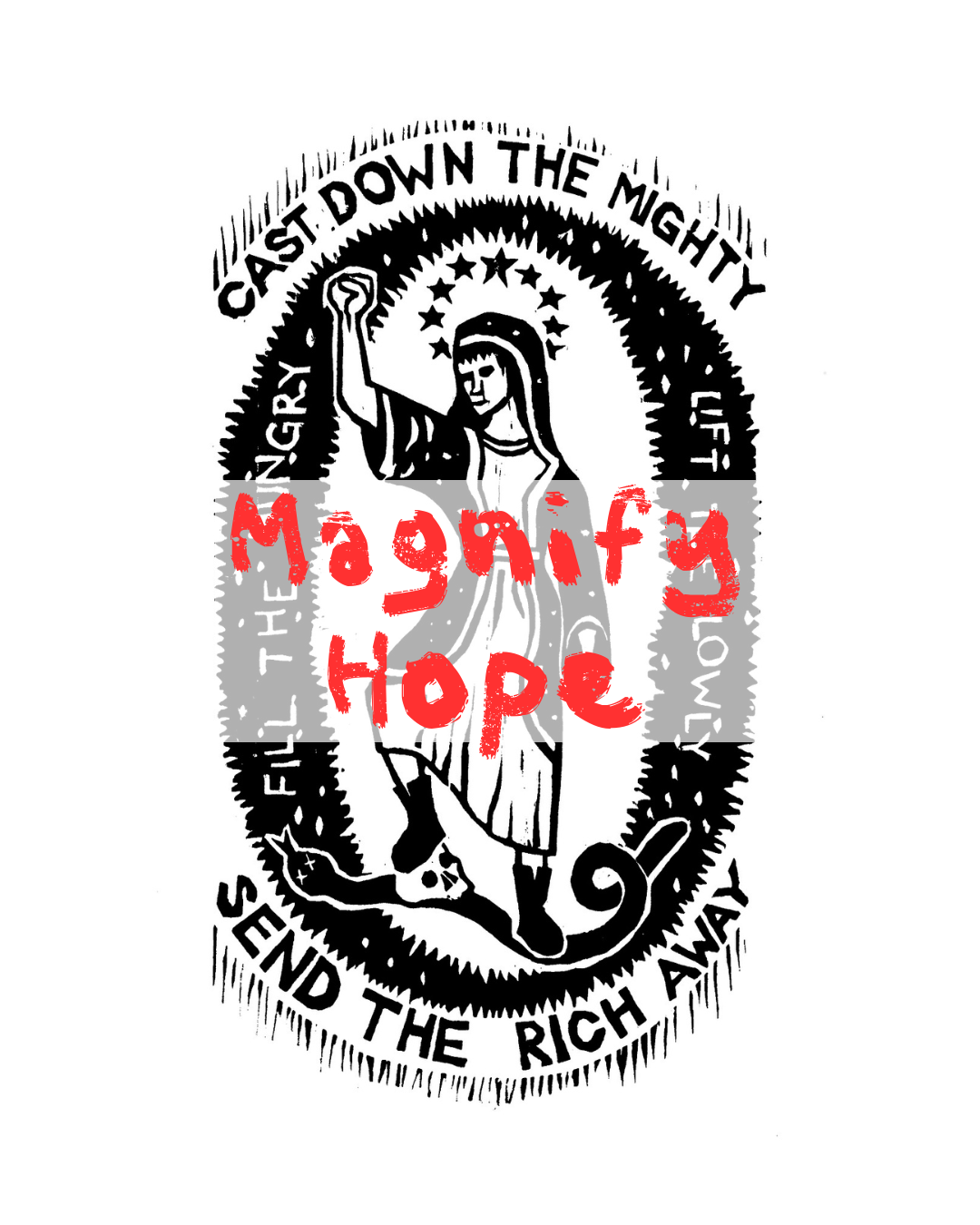
Advent 1: Magnify Hope
Text: Luke 1:46-56; Isaiah 2:1-5
Advent has begun! We had a kind of soft open a couple of Sundays ago with the scripture from Isaiah 9 about the people walking in darkness seeing a great light and then last week with the Christmas crafts. But this Sunday is really it. And each week we’re going to be hearing and reflecting on parts of Mary’s revolutionary hymn, called the Magnificat. Along with some other texts that are familiar ones for the time of Advent.
I call Mary’s song a revolutionary hymn, because what else is it other than revolution, when a tyrant is pulled down from his throne and the rich are turned away empty? Mary is singing (and we will sing a little later) that the world is about to be overturned. For those who are oppressed or hungry or weak: hope!
There is a story that circulates, which speaks to the power of this scriptural song, that the Magnificat was banned by the government from being used in public worship in Guatemala and Nicaragua during the years when those countries were under authoritarian dictatorships. It was too revolutionary. It aligned too much with rebel causes. I also read recently that’s not actually true.
It is definitely true that her song has inspired liberation theology – the theology that emerged from Latin American workers and marginalized peoples proclaims God’s preferential option for the poor. It is true that both liberation theology and the Magnificat aligned with the revolutionary movements in Nicaragua and El Salvador and Guatemala. And while not outright banned by those governments, it’s possible (and author Mark Allen Powell thinks probable) that it was discouraged from use. (Reference)
I could imagine that if a pastor or preacher stood in the context of a public worship with members of our own government and preached these words it would feel like quite an indictment. Because preaching the hope of the gospels magnifies the God who brings down the mighty and lifts up the lowly. Attends to the hungry and send the rich away empty. Extends mercy and calls on mercy – very much like Episcopal Bishop Mariann Budde did a year or so ago at Trump’s inauguration.
When Mary magnifies God, she is magnifying hope.
Mary’s song is called the Magnificat because of that first line: My soul magnifies the Lord – in the version we heard read today – glorifies the Lord. But I like magnify here.I like it even though I always found it a little curious – because to magnify means to make bigger but God is already the biggest imaginable, and even beyond imaginable. But I heard it put into perspective this way: Mary is putting God under a magnifying glass. Her song and her soul pull focus on God, make God the biggest thing in the picture, the center, the bright beam.
When Mary magnifies God she magnifies God’s favor and salvation.
She magnifies God’s mercy from generation to generation. She magnifies the one who, since the prophets, her ancestors sang of the One who would “judge between the nations and shall arbitrate for many peoples,” who would oversee a time when “they shall beat their swords into plowshares and their spears into pruning hooks.”
Mary magnifies a hope that is very different from a simple optimism.
Although hope and optimism can sometimes be used sort of interchangeably in conversation. When asked about the outcome of a situation and expecting the best, one might say they are hopeful or that they are feeling optimistic. But unlike optimism, hope expects – and even is an action. This kind of hope is what makes Mary’s song so revolutionary. Psychologist Kendra Thomas, who has researched hope and justice movements says,
…optimism can rely on a sense of luck over action. Self-help books on optimism are lined with hacks – like imagining your greatest possible self or focusing on the best-case scenario.
My psychology research studies how [that] long-term hope is not about looking on the bright side. It is a mindset that helps people endure challenges, tackle them head-on and keep their eyes on the goal – a virtue that [Martin Luther] King and other community leaders exemplify. (Reference)
She and her research team talk about ‘virtuous hope,’ which they define as “striving toward a purposeful vision of the common good – a hope often shaped by hardship and strengthened through relationships.” Hope connects us to other people!
Thomas talks about King’s ongoing hope even though he was not, in fact, particularly optimistic about his present circumstances. And he criticized white Christian moderates for their optimistic support or his goals with little or no action to back them up.
He chastised society for believing that improvement would simply happen on its own. When he said, “The arc of the moral universe is long, but it bends towards justice,” he was not describing its natural trajectory, but what people have the power to change. You cannot expect greener pastures if they are not tended today.
I have been guilty of using that quote to relieve myself of responsibility rather than using it to prompt me to engage more fully in hopeful action.
When Mary magnifies God, she magnifies hope in a way that seems to understand this bending of time and space.
Like the prophets before her – and I talked about this when I preached on Isaiah a couple of weeks ago – Mary uses the prophetic past. A way of speaking about God’s saving work with such absolute certainty that while we have not experienced the specific acts of salvation yet, it is as if they have already happened. Our hope is sure and we have a place in it.
In her book Expecting Emmanuel: Eight Women Who Prepared the Way Joanna Harader – notices that Mary actually mixes around her verb tenses when she talks about God’s activity in her own life and the life of the world.
Mary’s use of the past tense is an indication that she does believe that there will be a fulfillment of what is spoken to her – actually she believes there is already a fulfillment of the promise…
As she bears Jesus in her body, she lives the fact of God’s past tense activity (Jesus’ conception) that signals an already-here but not-yet-fully-realized liberation period.
When we speak of God, sing of God, think of God, I fear we often limit our verb tenses…One of the deep gifts of Mary’s song is that it holds all time together in the sacred space of the incarnation. It reminds us that the mighty one, embodied in Jesus, is our beginning and our end, the Alpha and the Omega, the one who was and is and is to come. In these days of Advent, as we prepare for the coming of the Christ child, may our hearts, like Mary’s, magnify our God!
This advent, as we prepare our hearts for Christ, may we not just magnify God, but magnify hope. A hope that is active in showing mercy, filling the hungry, lifting up the lowly and sharing the favor of the one who shows their preference for the meek and poor. As we prepare our hearts for Advent, may we sing and proclaim and live this revolutionary hope. Amen.