
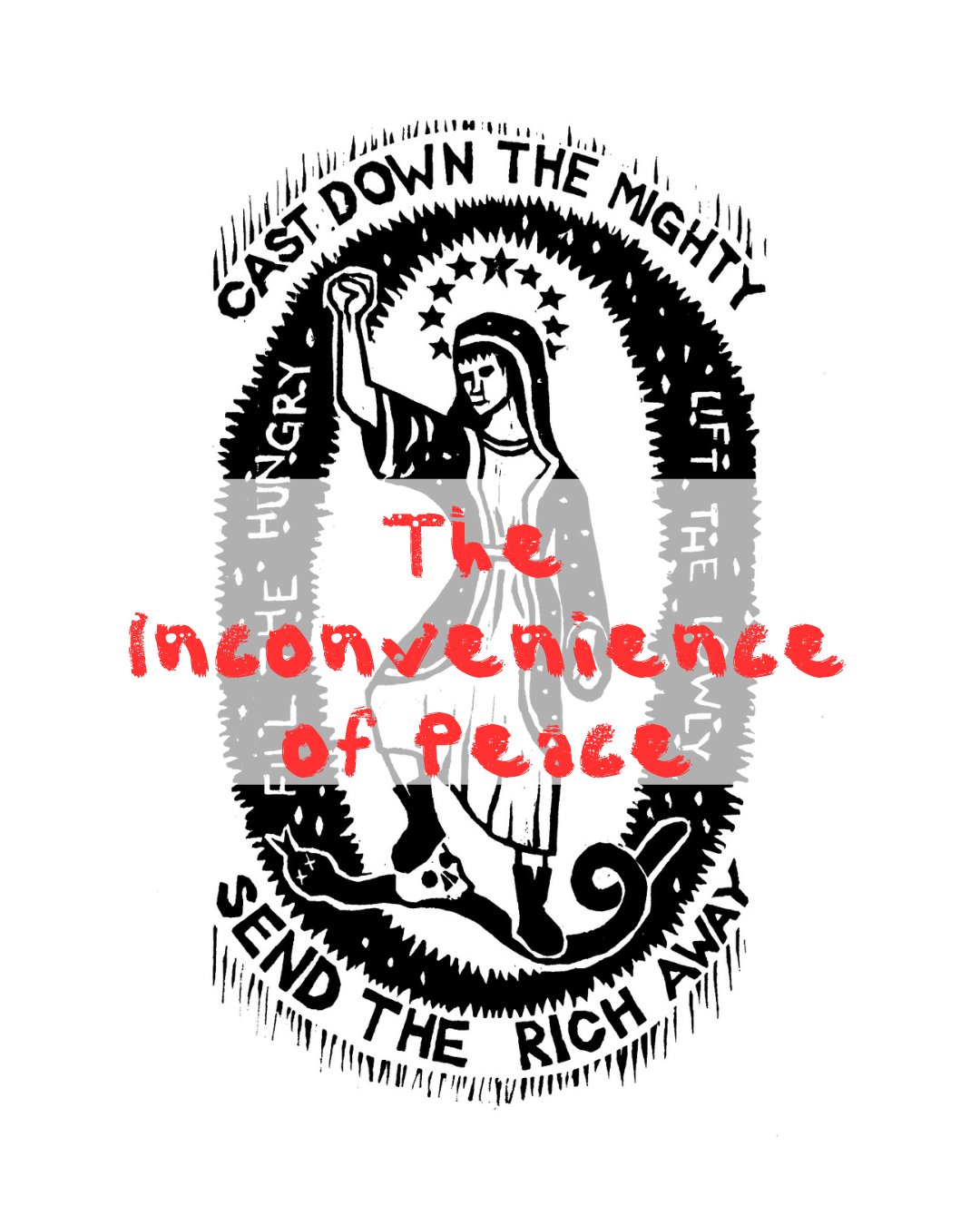
Advent 2: The Inconvenience of Peace
Text: Luke 1:65-76
Right off the bat, I want to offer some context for the poem of praise from Luke 1. Sometimes called Zechariah’s song or Benedictus, for the first words: Blessed be God.
You’ll remember that these folks lived in Judea – the region around Jerusalem – during a time of occupation. The king – Herod the Great – is a puppet ruler of the Roman empire. Octavian is emperor. It is in this setting that Zechariah lived with his wife Elizabeth in a small town or village. They are elderly and faithful and the first readers might have been reminded of folks like Abraham and Sarah in the Old Testament.
Like Mary’s song, this is a response to God’s action in the singer’s life. Zechariah’s son John has just been born. A son who is a miracle baby, born to these elderly parents who thought they could never conceive. This song is the first thing out of Zechariah’s mouth after a 9-month imposed silence; he had questioned the angel’s message and was cast into muteness for his doubt.
Earlier this week I was part of a monthly meetup of Mennonite Pastors across Washington and Pastor Emily at Menno opened the meeting with the question: How have you been inconvenienced by God recently?
I loved this question because it made me think about how probably, if we’re doing it right, the path of discipleship will sometimes feel inconvenient. Zechariah learned this the hard way! He questioned Gabriel, who was not having it, and subsequently couldn’t talk for 9 months. Which was probably quite inconvenient not only for him but for the people he served and for his newly pregnant (and elderly) wife Elizabeth.
His song of praise is a kind of partner to Mary’s song that we started Advent with last week. It is also a song of praise. But unlike Mary’s song he specifically has blessings both for God and for the child he is receiving into the world.
Zechariah sings of a God who has brought salvation from enemies. Salvation so that God’s people can worship in safety and security.
You have brought salvation from our enemies
and from the power of all those who hate us….You have granted that we would be rescued
from the power of our enemies
so that we could serve you without fear
Salvation isn’t really something that Jews talk about very much. Especially in the modern world, where that terminology has been very much co-opted by Christians and in particular evangelical Christianity.
However Jewish scholar and founder of the Jewish Reconstructionist movement Mordecai Kaplan likes the idea of salvation and he connects it to the Hebrew bible’s meaning of shalom. We often translate that Hebrew word shalom as “peace.” But shalom encompasses not just cessation of conflict but wholeness, fulfillment, healing, enoughness for all. That kind of robust idea of peace is what Kaplan had in mind when he talked about salvation.
I’m not entirely sure if, when Zechariah burst forth with this song of God’s shalom-salvation he was thinking of himself and his own people and their need to worship in peace. I do know that the Pax Romana (or Roman peace), under which he was a subject was, for its time an unprecedented cessation of warfare. And surely it brought a common good like roads and viaducts and other infrastructure.
It was also (I’m quoting wikipedia) the “rare situation which existed when all opponents had been beaten down and lost the ability to resist.” That does not sound like shalom to me. That sounds like oppression and domination. Rome’s roads and bridges were accompanied by a culture and religious domination. Jewish culture and practices were under threat.
In that same meeting of pastors when Emily invited us to think about how God has inconvenienced us, our District Pastor Sylvia reminded us of the congregations in our conference who are literally feeling like they are under threat. Like they can’t gather to serve and worship God in safety.
They are fearful. They continue to ask us to pray. Members of Portland Mennonite – including Sylvia – have taken to praying with their bodies. While Ministerios Restauracion worships indoors at Portland Mennonite, PMC members gather to pray outside in the parking lot and walking around the building.
They create a barrier with their prayers and with their bodies that provides salvation for their Mennonite kindred to worship without fear. It is inconvenient. I’m sure they would rather be doing something else with their Sunday afternoons. But if they were not there, Ministerios may have needed to move to online worship like Eglesia Vida Nueva has already done because their members do not feel safe to gather in person.
Creating safety, an environment of peace and wholeness and healing for the most vulnerable members of our communities makes all of us more safe, even if it feels like a hassle, or inconvenient and annoying in the making.
Last week or the week before I mentioned in announcements that what was once a La Quinta Inn in south Kirkland has been transformed into permanent supportive housing for vulnerable folks in our region. They’re focusing on unhoused folks with disabilities of one kind or another. And to no-one’s surprise neighbors in the surrounding area are upset that these accommodations have been created. They are worried about safety for themselves and their children.
From my time at Seattle Mennonite, where there’s a long history with people who are on the margins, who are unhoused or disabled or mentally ill I know that the more stability and safety you can offer to folks living under those circumstances, the safer it is for the whole neighborhood. The less trash there is on the ground, the fewer needles, fewer people panhandling, less burden on emergency rooms.
But it’s also inconvenient. If that place is in my neighborhood, I need to think about it. See it when I drive home or take my kids to school. I am confronted by the systems that allowed folks to be so vulnerable. Think about my complicity in those systems. I might need to talk about it with my children. It interrupts my idea of who I am and where I think I fit.
Mordecai Kaplan was active and writing about peace and salvation in Judaism in the time immediately following the Second World War. I mainly learned about him second hand through people talking and writing about him so I’m not sure how he viewed the founding of Israel or its creation as a place of safety for Jews after a time of severe persecution and threat. [ed. note: I have since learned that Kaplan was a life-long Zionist and “that Jewish civilization required the natural setting of its own land in order to flourish and grow”( About Mordecai Kaplan | The Mordecai Kaplan Center for Jewish Peoplehood)]
But I can imagine that, just as the Psalmist we heard calling out to pray for the peace of Jerusalem, that he must have seen that place as a refuge. So many American Jews, even now, understand Israel in that way. A place that is free from the anti-Semetism that they fear in every other space they inhabit.
And now, these many years later, while Israel may be that, it is also profoundly unsafe. Unsafe because of the oppression and domination of the occupation of Palestine. And unsafe because violence begets violence begets violence. If Palestinians were safe and experiencing the shalom of peace and safety, I believe Israelis would also be safer and more secure.
In the second half of his poem of praise, Zechariah sings of the way his son will prepare the way for this safety and salvation. Prepare the way for peace.
You child, will be called a prophet
of the Most High,
for you will go before the Lordto prepare a way.
And indeed we see that play out in the chapters to come, as John the Baptist initiates Jesus to his ministry of peace-making and non-violence and healing and sacrifice.
One of the Christmas songs that makes my Advent playlist every year is a song called “O Little Town of Bethlehem” by Over the Rhine. And it’s not the hymn you’re thinking of. It has a different tune. And although it starts with the same words of the traditional hymn, it shifts.
The lamp lit streets of Bethlehem
We walk now through the night
There is no peace in Bethlehem
There is no peace in sight
The wounds of generations
Almost too deep to heal
Scar the timeworn miracle
And make it seem surreal
The baby in the manger
Grew to a man one day
And still we try to listen now
To what he had to say
Put up your swords forever
Forgive your enemies
Love your neighbor as yourself
Let your little children come to me
We still try to listen to what he had to say! We are being called even now to follow him. In Jerusalem and Bethlehem and Gaza, in Seattle and Kirkland. This baby in the manger that this season is pointing toward. He is calling us to paths of peace, love, welcome and inclusion.
One or two of you may have read my note in the e-memo this week about being a part of a Fast for Gaza. This was a fast that was a project of solidarity and action initiated by a group of parents and passed from one group to another all across the country, each fasting for a week – to remember the hungry people of Gaza and accompany the fast with action and advocacy.
I didn’t really want to do it. I did it with a kind of resignation. Like, “Ugh, I guess this is what I need to do.” Sigh. I also didn’t enjoy it while I was doing it. It didn’t feel good. I was cranky. I was distracted.
It did however continually keep my mind on people who are suffering. Which was the intention. And that also didn’t feel good. I don’t want to think about bad stuff! I don’t want to think about my responsibility. It is very inconvenient and annoying!
Here’s what keeps me at it: Being inconvenienced together. Showing up together. Like Sylvia and those PMC members in the parking lot. Whether it’s the training with other PTSA members for immigrant justice or writing notes to La Quinta residents with y’all or fasting with Mennonite Action and checking in with others on the Signal thread or giving up precious Saturdays to drive to West Seattle or Greenlake with my sewing machine and tools in tow.
Those things are literally just inconveniences, not true suffering, not even risk, though some are called to that in the name of peace. But the inconvenience of peace-making is slightly less inconvenient when we do it together. When we practice it together. When we are accountable and encouraging and supportive together. How will you let God inconvenience you for peace? How may we do it together?
—