
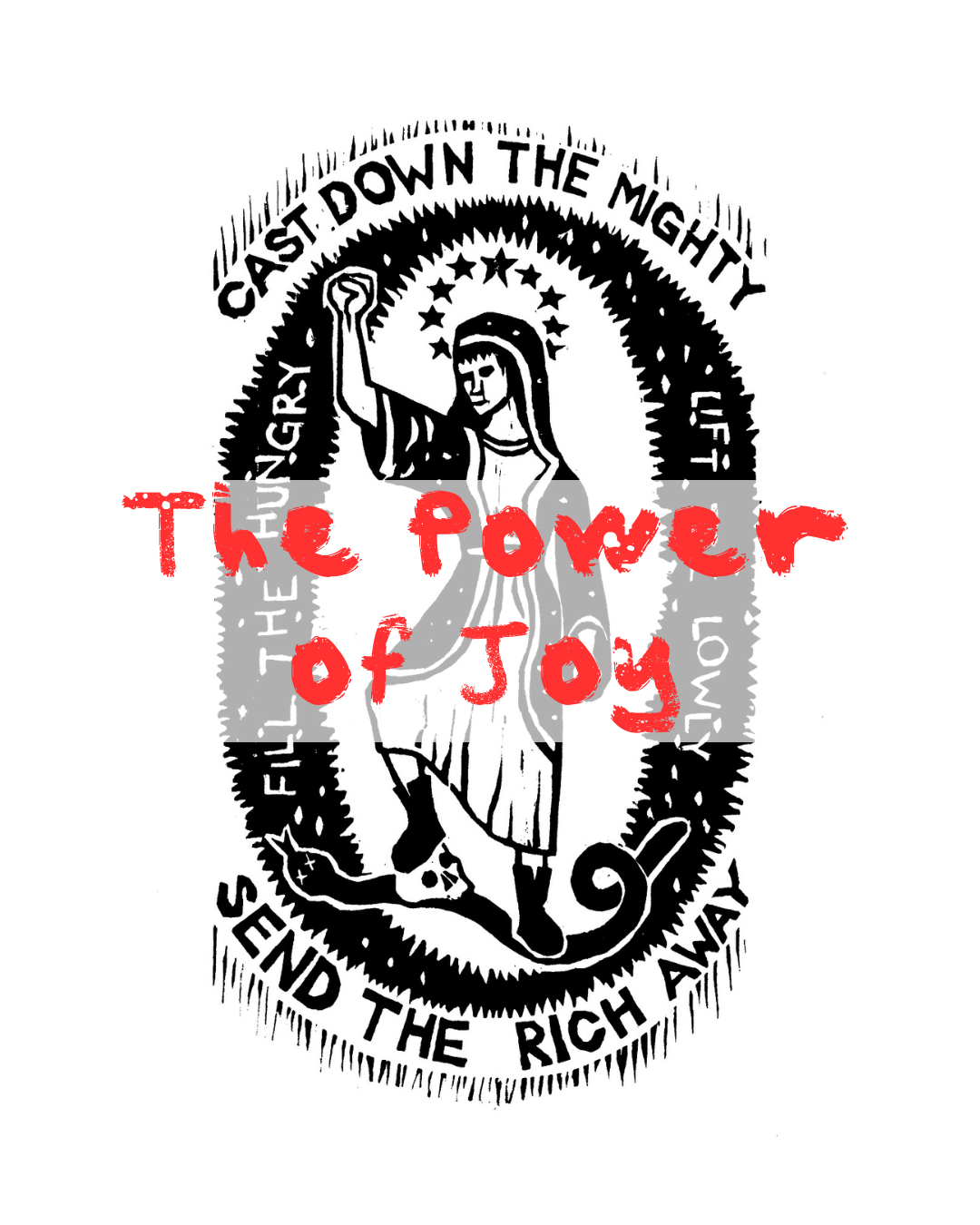
Advent 3: The Power of Joy
Text: Luke 1:36-56; Isaiah 35
“From the depths of who I am, I rejoice in God my Savior.”
That is quite a thing to say when you are a young, poor, unmarried, pregnant girl. To be proclaiming joy and triumph while you are at the same time seeking comfort and care from your old auntie Elizabeth in a time of uncertainty and possibly crisis. The feelings that I would think Mary – or any other pregnant teen – might be having are fear, worry, confusion, shame.
We don’t hear a song from Elizabeth, but she is the one who surely could be rejoicing in earnest. At her advanced age she is pregnant with a longed-for child. In a culture and community where motherhood is where women find identity, she finds a place at last.
Her joy (Elizabeth’s) might be a little like that expressed in Isaiah 35. A relief after a long exile. New life after years of dry wilderness. A sprouting and growing.
In spite of her position, Mary’s joy anticipates a newness too. Her joy trusts in a God who brings those things to life. Who brings captives home and pulls down the mighty and fills up the hungry and all the things I talked about in my first sermon in Advent.
For both of these women joy comes bound up with pain or sorrow or fear. Mary, for all the things I just named. But Elizabeth, while she is surely ecstatic at bearing a child in her old age, she may be wondering how she will care for the baby, how much of his life she will see. Plus, her husband is also old. And he can’t speak, which is surely a worrying and confusing situation.
And in the wider picture, as I talked about last week: the political situation is one of occupation – both political and cultural. And along with occupation, oppression.
In the complexity of personal and political struggle, for a people oppressed or occupied, for an individual uncertain or alone – or any of the things that Mary or Elizabeth or any of us may be experiencing, joy can be a powerful force of resistance.
Before I go on, I want to be clear that when I talk about joy, I am not talking about ‘holiday cheer’ or the holly-jolly-ness that is so prevalent in Christmas songs and movies and other media. Joy is not even happiness. Because joy makes room for sorrow. Joy makes room for and can even be experienced during times of loss and injustice and pain.
Claiming and expressing joy is an act of personal and communal care. I noticed that the joy that Mary and Elizabeth express is as they come together to share their experiences with one another. Joy is sustaining, connecting, hope-creating.
George Lakey is Quaker activist and sociologist who was a part of the Civil Rights movement. And he writes in an article called, “How can I keep from singing, even in grim times?” about the way joy – and especially singing with joy – empowered the non-violence protest movement.
When in jail with Black activists in the 1963 nonviolent campaign in Chester, Pennsylvania, I learned to keep my spirits up by joining them in their freedom songs, singing “Ain’t Gonna Let Nobody Turn Me Around,” “Oh, Freedom” and “We Shall Overcome.”
The Black Panther Party, on the other hand was not known for non-violence. Rather the opposite. But they too claimed joy as a part of the resistance of white supremacy and racism.
behind the leather jackets and raised fists was a profound emphasis on community care, creativity, and joy. They weren’t just marching, they were throwing block parties, feeding children with free breakfast programs, running health clinics, teaching political education, and building cultural programming. The BPP created safe spaces where people could smile, dance, eat, and imagine something beyond state violence.
Not only did those spaces do exactly what Mary sings about – fill the hungry with good things and lift up the lowly, they created community pride and togetherness and thriving. An affront to systemic oppression. [Le’Jai’La Troi, Sustaining A Revolution: Why Joy Is a Weapon for Activists Fighting the System]
Tyrants and dictators and authoritarians cannot stand silliness or a joke or anything that makes the power of the system that they’ve created look weak. Tyranny is so self-serious. This is another reason that engaging in joyful and silly and irreverence as a form of resistance is so effective and humor is so threatening. It’s why Kimmel was canceled and Stephen Colbert is being taken off the air.
But of course it’s not just famous late-night hosts whose creativity and humor are meeting the political moment. It’s inflatable frogs doing zumba or whatever outside of the ICE facility in Portland. As a tactic, being silly as a response to violence is immediately clearly unthreatening, disarming. And because the power differential is so visually evident between armed officers and blow-up froggies, it also creates a shocking media story. Plus all those blow up frogs and unicorns were – like the singing in jail or the Black Panther breakfast programs, building community and resilience.
One of my favorite stories of this kind of silliness as a tactic for protest was written into a picture book called White Flour by David La Motte. In 2012 a White supremacist group had planned a rally in Knoxville – full of hateful signs and slogans and chants. In the picture book, as they suited up in the hoods and robes and began their march, chanting, “White power,” they found they were joined by another group: The Coup Clutz Clowns.
The Clowns did what clowns do – they were silly. They kept intentionally mis-hearing the chanting: White flour! they’d yet and the air would be full of powder being thrown back and forth. Wait no! They said, White flowers! and white flower petals floated over the marchers. And my favorite: Wife power! And suddenly wedding dresses appeared and the clowns marched on dressed as brides.
In the face of such silliness it is very difficult to continue to shout messages of hate. In the same way, the ‘war zone’ of Portland was shown actually to be streets full of music and dancing. “Happiness and joy overwhelm them,” as Isaiah says.
Like Isaiah and other prophets, Mary in the Magnificat sings for joy even in the face of oppression. Not only is that joy and expression of trust in God and connection to the community of God, it defies those with power who would want to dictate to who and how one’s rejoicing is directed. Mary is certain of God’s power – not the puppet Herod not the Emperor Augustus, the God of her ancestors, the God who makes
the wilderness…rejoice and blossom like the crocus.
They…burst into bloom, and rejoice with joy and singing. [Is. 35:1-2]
Advent is a season that highlights the already/not yet nature of the Reign of God. Now more than ever we anticipate the in-breaking of Christ, the coming of God’s Kingdom. But we already know what it’s like. Isaiah and Mary describe it for us. We can embody that joy-filled spirit now, even as we tenderly hold the brokenness and sorrow and injustice of the world.
I will end with a quote from Ross Gay, author of Inciting Joy and The Book of Delights, who says this:
My hunch is that joy is an ember for or precursor to wild and unpredictable and transgressive and unboundaried solidarity. And that that solidarity might incite further joy. Which might incite further solidarity. And on and on. My hunch is that joy, emerging from our common sorrow—which does not necessarily mean we have the same sorrows, but that we, in common, sorrow—might draw us together. [Ross Gay, Inciting Joy]
May our joy draw us together through sorrow. May our joy indeed bloom into unboundaried solidarity against all that is tyrannical and oppressive and violent. May our joy draw us toward God, who, even now, is making all things new. Amen.
–