
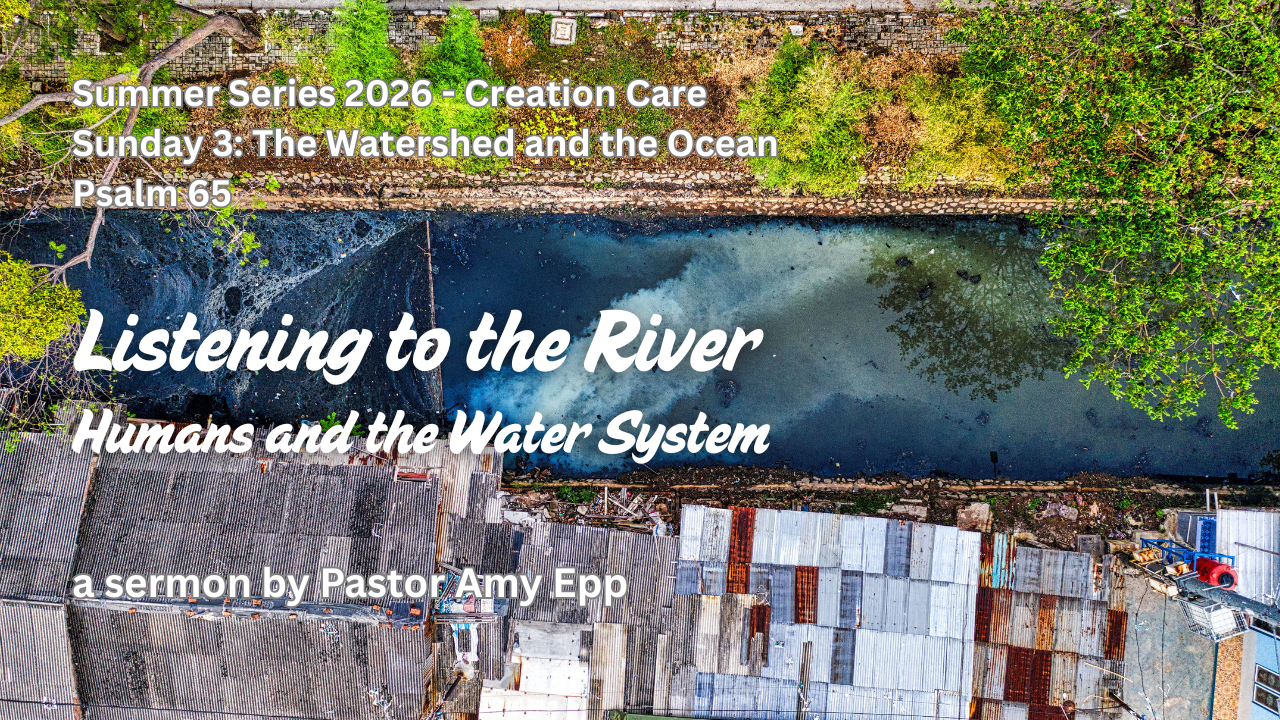
Listening to the River
Text: Psalm 65
We’re now in our third week of looking at the Bible with a lens of thinking about the natural world. And as I’m spending time with these texts that are essentially poems or songs about God as creator and about the functioning of the earth and water and sky, I am struck both by how different the ancient writers were in their relationship with the natural world and also how we are still the same.
Obviously, the ancient writers didn’t have the kinds of mass human-caused environmental concerns that we have now: a floating garbage island, microplastics (or any plastics), pollution from particulates and from light and from sound, etc. They had a much closer relationship with the cycles of the earth. I talked about that in my sermon on Genesis one.
And also, like us, especially when we pay attention to our relationship with the natural world, we share and awe and wonder. Why else would cute animals be so popular on the internet. It can’t just be my algorithm that’s feeding me the live baby eagle cam and cats learning to use language by pressing buttons. And like the ancients we also lament when we see Creation harmed and recognize our own role.
Poets are the best at this, I think – whether that’s the Psalms or poetryfoundation.org, where I’ve turning to look for poems for this series. Today I’ll be sharing a poem by Jane Hirschfield. She’s been writing since the 70s but has recently focused more and more on connections between poetry and science.
I don’t know her faith background I suspect that she knows something about the Creation story that we began with because the poem I’m going to read is called, “On the Fifth Day.” It was on the fifth day that the creatures of the waters and air were created and when God blessed them and called them good and told them to be fruitful and to multiply and to fill the seas and skies. And maybe you’ll also recall that while humans also received that same blessing, when we act to hurt or destroy these creatures, we are undoing that blessing.
On the fifth day
the scientists who studied the rivers
were forbidden to speak
or to study the rivers.
The scientists who studied the air
were told not to speak of the air,
and the ones who worked for the farmers
were silenced,
and the ones who worked for the bees.
Someone, from deep in the Badlands,
began posting facts.
The facts were told not to speak
and were taken away.
The facts, surprised to be taken, were silent.
Now it was only the rivers
that spoke of the rivers,
and only the wind that spoke of its bees,
while the unpausing factual buds of the fruit trees
continued to move toward their fruit.
The silence spoke loudly of silence,
and the rivers kept speaking
of rivers, of boulders and air.
Bound to gravity, earless and tongueless,
the untested rivers kept speaking.
Bus drivers, shelf stockers,
code writers, machinists, accountants,
lab techs, cellists kept speaking.
They spoke, the fifth day,
of silence.
In Hirschfield’s poem, the silence that she speaks of is a silence of suppression. voice being suppressed is the voice of scientist – also anyone (cellists, bus drivers, coders) – who were trying to amplify the voice of the waters and creatures themselves. That’s a kind of silencing that feels very familiar. Spending on the environment and agencies that protect wilderness are being cut left and right.
The Psalmist also writes of silence: “To you, silence is praise…”
The Psalm starts out pretty person-centered. Human praise and human experience. But it doesn’t stay there and the human is never alone: “You listen to prayer,” the psalmist says, “and all living things come to you.” The psalmist notices God’s hand in all things – not just all living things but all of Creation, including the movement of the waters, from the edge of the ocean to the rain that falls to soften the earth for planting and growth.
In the psalm the quieting of human noise – praise in silence – allows the quieter voice of Creation to be heard. The few time that I’ve participated in Wild Church this is a very literal practice. The gathering starts together with others in song or scripture or readings, much as we’ve done today, but then is intentional about solitary and silent worship in the presence of Creation. Most recently I did this with Community of Hope in Bellingham, where we were in a park at the north end of Lake Whatcom and my worship included hearing the very gentle lapping of the water on the pebbles of the shore.
But that kind of experience doesn’t only happen in worship. It also happens when I decide to take out my earbuds when I’m walking the dog on Chief Sealth Trail or walking around or through Seward Park. Silence in God’s presence allows us to hear the music of the shore, the river, the babbling brook, the falling rain. I wouldn’t be surprised if each person here had a similar story of just being quiet outside and noticing or appreciating something in a new way.
What Jane Hirschfield points out is that the rivers never stopped speaking – whether we are paying attention or whether we are speaking for them or whether they are noticed. She writes, “the rivers kept speaking/ of rivers, of boulders and air./ Bound to gravity, earless and tongueless,/ the untested rivers kept speaking.”
There are people who continue to amplify that voice – to notice the importance of waters and the watershed to our ecosystems. Several times in worship I’ve read the children’s book We are Water Protectors which documents one indigenous child’s determination and pride in her people’s strong allyship with the earth and watershed. It arose out of the movement at Standing Rock several years ago to protect both indigenous and non-native farmland from an oil pipeline.
Indigenous folks both here locally and nationally and internationally are also speaking and being silenced and spoken over. Sarah Augustine, who we now know from her worth with the Coalition to Dismantle the Doctrine of Discovery started her work with indigenous communities in Suriname. Hearing women talk about the way their waterways – which were their very life, through fish and drinking and washing – were being poisened by mining and mineral extraction.
Their waterways poisoned meant they were poisoned. And the system offered nothing by way or either protection or compensation. The Suriname Indigenous Health Fund was born as Sarah and her husband Dan advocated for those Wayana communities. Since then Sarah has had audiences at the UN and the World Council of Churches and now continues her advocacy through the Coalition.
The Psalmist sings of a God who dwells in the waves, who visits the earth with abundant water to nourish it, who softens the earth with rain that blesses growth. If this is a system and cycle that we want to protect – which we should, because regardless of our distance from it, the earth and watershed are where we get our food too, even if it’s not pulled directly from the river – if we want to protect it we should listen to and amplify the voices of those closest to it.
In the Seattle area, I’m most familiar with the work of the Duwamish Tribe. Their website says,
The Duwamish Tribe is committed to restoring the water and land. The tribe’s ancestral homelands are along the waters of Elliott Bay and the Duwamish River Watershed. Native plants and animals of the area were a part of our culture and heritage as well as the source of our food and shelter.
They have worked really had to advocate for the Duwamish River system, including partnerships community environmental orgs and as founding members of the Duwamish River Community Coalition, which has a mission to “ensure a Duwamish River cleanup that is accepted by and benefits the community, and protects fish, wildlife, and human health.”
I am grateful for their work and it’s one of the reasons that I pay Real Rent – a small amount each month that acknowledges that although I may have a deed to the land that I live on, the land and the watershed were not given up honestly. It’s not a large amount but it’s my way of remembering who the original and ongoing steward of this place are. I feel very grateful to live in a place where water is abundant. So much so that it is easy to forget the limited resources that we need to share with people and animals alike.
My closing poem is short, and it makes that point that we are all connected to each other and to the water. Like the Psalmist, may our praise and our loud voices find silence, so that the voices of the earth and the water and those who have protected them for so long be amplified. Here is ‘Kelp’ by Jeffrey Yang.
Kelp, by Jeffrey Yang
How easy it is to lose oneself
in a kelp forest. Between
canopy leaves, sunlight filters thru
the water surface; nutrients
bring life where there’d other-
wise be barren sea; a vast eco-
system breathes. Each
being being being’s link.