
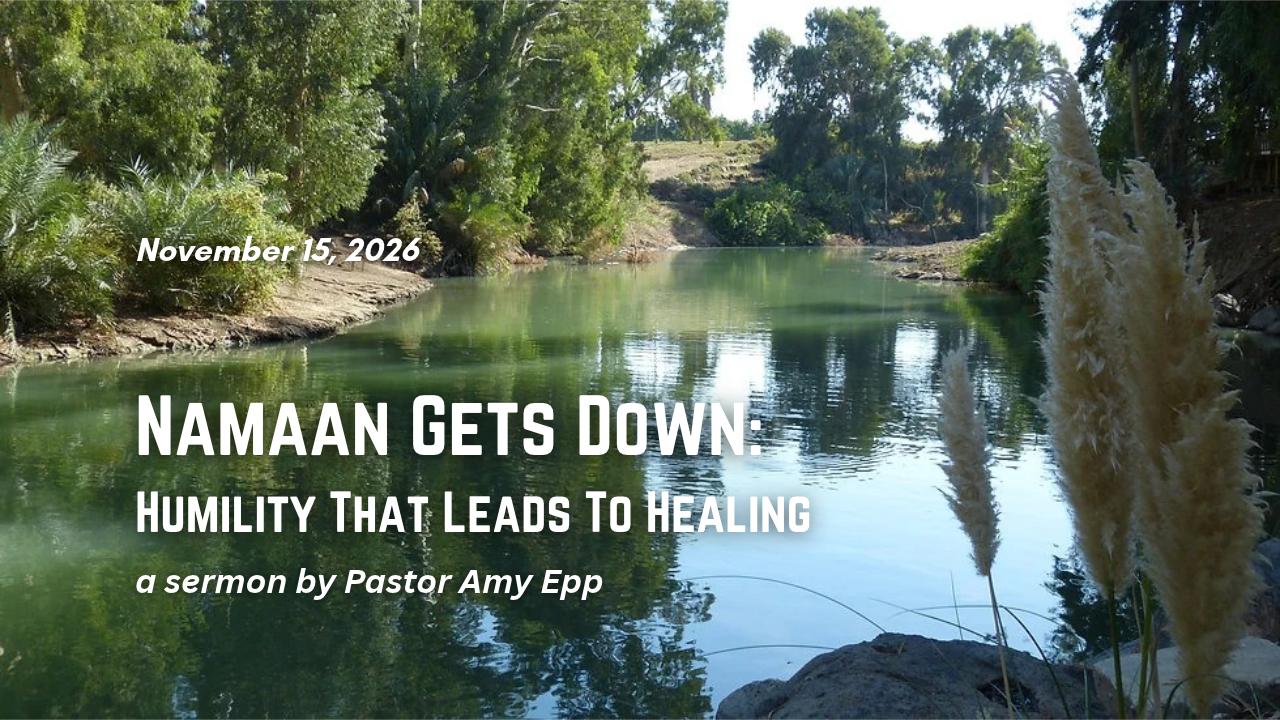
Namaan Gets Low: Humility that Leads to Healing
Text: 2 Kings 5:1-15a
Maybe you’ve heard this story before: In a faraway kingdom lives a talented quiltmaker who sews exquisite, colorful quilts that she only offers as gifts and only to those who are poor or homeless. Meanwhile, this kingdom is ruled by a king who surrounds himself with his great wealth and endless material possessions. And not only that, he demands presents from all of his subjects. And, by the way, he’s miserable.
When the king hears of the beautiful and charming quilts from this craftsperson, he demands one for himself. As I’m sure you’ve anticipated, she will not give him one. After all, he’s certainly not poor and he needs for nothing! Though he tries to force her and imprison her she still refuses.
But the quiltmaker is willing to make a deal: she will sew a quilt for him, but only if he gives away all of his possessions piece by piece, adding a patch to his quilt for every gift he gives.
Reluctantly, the king starts giving away his treasures—marbles, velvet coats, waltzing cats, and toys—to people who need them. With every gift, he sees the joy he creates and feels a genuine, growing happiness. Once he has given away everything and becomes poor, the quiltmaker finishes his special quilt. Instead of clinging to wealth, the king joins her as a partner in sharing kindness and distributing gifts to those in need.
I think I first heard this story, The Quiltmaker’s Gift, when Kate read it at Camp Camrec. At least that’s what I remember, is hearing it during a meal with all the campers listening raptly.
The book itself is quite long for a picture book so I didn’t try to find it to read in its entirety, but I did think of it while I was spending time with this story about Namaan, another rich and powerful man who has a reason to be a little miserable. What Namaan experiences is something like what this king experiences. Namaan needs to get down from his high horse – in his case literally! – to experience the transformation and renewal that he is seeking.
I am very wary of glamorizing poverty or making poor people heroes simply because the are poor. It is not glamorous to not have enough or to be scrambling to make ends meet. It is stressful and difficult and often humiliating. This folk take does kind of come at it from the glamorous and romantic angle but I would not say the same of scripture.
This story about Namaan recognizes the great difference between those who are humble and those who are high and mighty and give the poor – the servants and enslaved people – an important and influential voice. It questions the expectations of power and invites humility that points to power belonging to God.
There are a lot of stories about kings and powerful leaders in this fall and winter stretch of Bible stories. And I have a hard time not reading about the powerful men in the Bible and not comparing them to the powerful leaders in our midst – for better and for worse. You can draw your own conclusions and comparisons from my description.
Hierarchy and channels of power are very important to Namaan. As I was reading this passage – I had it printed out on a sheet of paper – and I started to underline all the places that drew attention to power or influence or wealth. There were a lot of underlines! Things like “mighty warrior,” “victory,” “great man and highly regarded.”
Then there are the references to all the wealth and money, the horses and chariots. There is a chain of command working through the kings, levels of masters and servants – whether Namaan to his king or the servants to Namaan or to his wife. Namaan seems pretty obsessed with power. Maybe it’s because he is a soldier it needs to be very clear to him who fits where in that structure of power and mastery.
To me it was really clear that this story wants to tell us how powerful power is – and also how God’s way to healing has nothing to do with kings and wealth an everything to do with listening to those on the outside and the underside.
In Korean culture, there is also a very strict understanding of social hierarchy and honor. Elders especially are very respected and those with more years of experience in a given arena. It’s embedded into the language; you use different verb endings and more formal speech for those who are older versus younger and different forms of address.
For example a different word or address for a schoolmate who is older versus younger versus the same age and the same thing in families and workplaces. You need to ask permission or be very close to someone older than you to shift casual language forms or address.
There is a strong hesitance to question someone above you in status or age or experience. That hesitancy was the cause of problems for a period of time in the airline industry. Younger pilots would fail to question or challenge older pilots even when they noticed or experienced an issue or danger, which led to accidents or close calls.
The number of incidents kept rising and it wasn’t until the aviation industry brought in non-Korean investigators that they discovered just how many co-pilots or younger team members weren’t speaking up out of respect and honor. And that was the point that they began building in new protocols for feedback so that there was greater equity and freedom to speak up.
In this story about Namaan, to their credit, his servants and underlings don’t seem to have that same hesitancy. I think the storyteller knows this and wants it to be remarkable. It’s important that the solutions are coming from those who have the least power and access and resources.
To Namaan’s credit, he is willing to listen to them! It’s a bit of a journey. He needs a few reminders, but he does end up back on the banks of the Jordan. And there isn’t anything special about the Jordan. It too is humble. Namaan does need to get down. From his high horse and chariot. To the level of his servants. And down into the water.
Namaan needs to leave behind his expectations that listening to kings and overspending is where healing will come from. Unlike the king in the quiltmaker story, he doesn’t need to give away everything, but he does need to listen to those lower on the social ladder than himself and recognize that there is wisdom there. That lowkey (as the kids say) that’s where God is at work.
Many years ago, when I was first starting out as a pastor, Seattle Mennonite was also just getting started in its ministry to unhoused folks. I had previously worked in settings with people who were marginally housed and in foodbanks and resource centers. But I learned in those first years at SMC about listening to the humble and how that was healing for them and for the neighborhood.
Generally, we learned from those where were experiencing homelessness that they didn’t need beautiful quilts ala the Quiltmakers Gift but were more likely to want a safe place to store their stuff so they wouldn’t have to worry about it while they were at work, or bus tickets to get the their doctors’ appointment or a place to cook a meal at the end of the day. In general, when unhoused folks could share resources and be heard and receive a measure of safety, not only were they safer and cleaner and more healthy, so was the neighborhood.
As Namaan lowered himself – literally and figuratively – to find healing for himself, he also discovered the spiritual fullness of God’s work in and through him and created repair and strength and healing between two enemy nations. Working through the structure of hierarchy and king to king pay-off diplomacy only led to one king thinking another was trying to provoke him to war. But when Namaan listened to a captive slave girl, to his servants, he found healing both for himself and for many.
As is so many Biblical stories, there’s almost never a one-to-one correlation with contemporary experiences and systems. But we are very familiar with the social structures that privilege those with power and wealth and isolate or disadvantage those without those things. When we are willing to listen to the humble of this earth, that is where healing will be found. When the powerful are willing to give up some measure of that power, to take up humility and listen to the humble – everyone will experience healing. May it be so.