
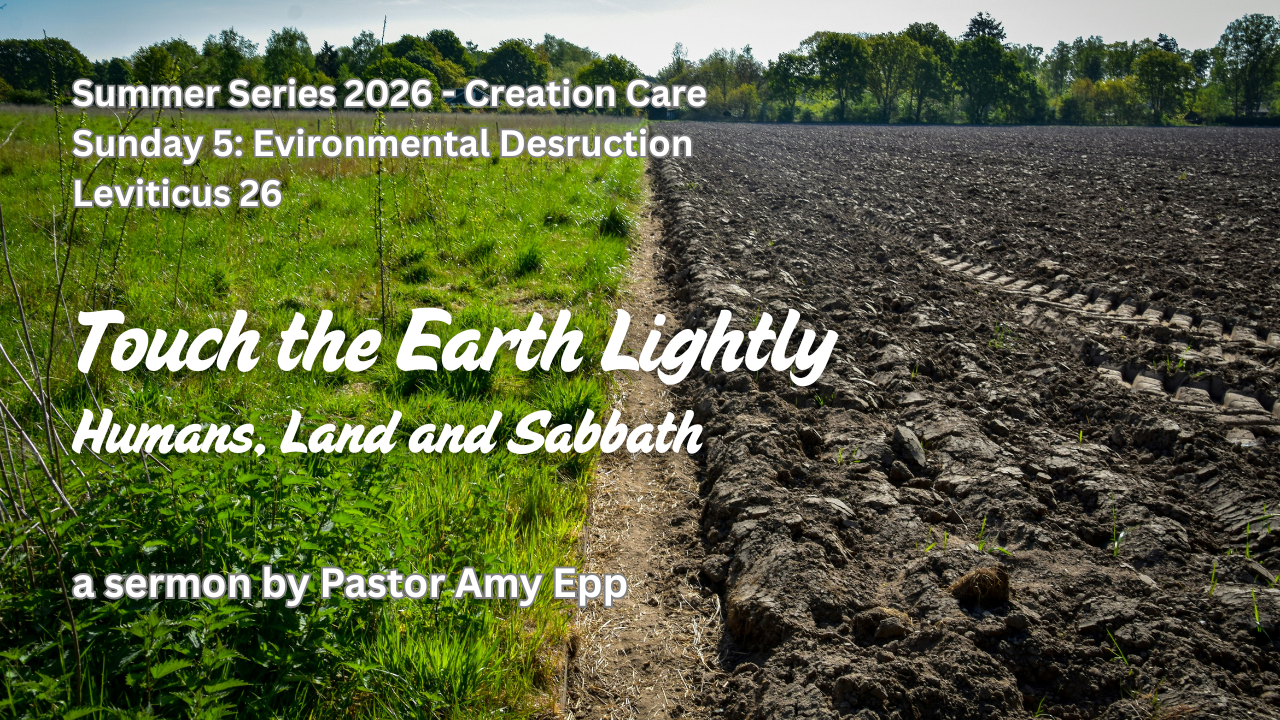
Touch the Earth Lightly
Text: Leviticus 26:3-22, 34-35, 40-45
I’ve started my last several sermons in this series about the environment with poems. But for this passage from Leviticus, it was a novel that came to mind. I’m going to read a short passages and then I’ll say more about it.
The absence of birds made Diz uneasy, but he wasn’t spraying birds, was he? Yet there were fewer birds around his farm. Used to be robins hunting worms in the furrows. Used to be blackbirds around the green bins. Owls at dawn, rats in their claws. Well, maybe he had a sudden thought those could have been the rats and mice he had to poison. He thought back to how birds used to chatter as the sun rose. Now, a few sparrows, maybe, or more often just the hiss and boom of wind.
This is a little bit from a novel called The Mighty Red by Louise Erdrich. I love absolutely everything I’ve read of hers. I can’t get enough. In part because she writes about land I understand in my bones. Prairie land – both before and after white settlement. And this book in particular, lives on the river that flowed through my life for eight years, when I lived in Winnipeg. Even though it takes place further south in Minnesota.
Erdrich has said that what she writes isn’t intentionally political or trying to make some kind of an activist statement. But when she writes about farmers and families impacted by debt and drought and the relationships between indigenous people and farmers and land, she kind of can’t help but make statements about those things.
Diz, who’s referenced above is a farmer who is starting to notice the way that continually dousing his land with Round Up© is starting to leach life out of the soil. Notices that it doesn’t hold water and immediately turns to dust, even after a heavy rain. He argues with his wife, who worries about the hazards of pest- and herbicides for his health. And he has begun to take note that his neighbor, who’s chosen to eschew chemicals, has land that still thrums with the song of meadowlarks and flutter of butterfly wings.
I think of this book a lot. And I thought of it this week as I read this from Leviticus 26:
…if you reject my rules and despise my regulations…breaking my covenant—then I will do the following to you: I will bring horrific things: wasting diseases and fevers that make the eyes fail and drain life away…You will plant seed for no reason because your enemies will eat the food… I will destroy your prideful power. I will turn your sky to iron and your land to bronze so that your strength will be spent for no reason: your land will not produce its yield, and the trees of the land won’t produce their fruit.
Because what Diz notices is that even as he works harder and harder to force the land to produce, the crop—sugar beets—is diminishing.
In the passage immediately before this one from Leviticus, God gives the people instructions for Jubilee. I’m sure I’ll get to talk much more about Jubilee in our next summer series on Economic Justice, but one thing to know about it is that in addition to people receiving sabbath, the land, too, receives rest.
This isn’t necessarily a go-to text about Creation, but you can’t really read the Hebrew Bible –- or any of the bible –- without the text coming back to the land. From the Creation story, to Psalm’s recognizing the beauty and bounty of the earth, to Jesus’ parables about planting and growing, to texts like this, which are a part of the law that was given to the Hebrew people when they were liberated from Egypt.
Jubilee is an extension of Sabbath law. God instructs the people that every seven years there is to be complete rest for the land. The earth itself is treated as a beloved member of the system. It’s cared for tenderly, as a living thing – which it is!
Sheri Hostetler and Sarah Augustine write in So That We and Our Children May Live,
…we don’t even understand soil, the substrate that supports life. A handful of healthy soil contains more living organisms than people on earth. That handful may contain billions of bacteria, millions of fungal cells, and thousands of arthropods, algae, protozoa, and nematodes. Soil scientists have not classified many of these species and don’t understand how they function within the soil ecosystem.
The people of Israel didn’t understand bacteria and fungal spores and protozoa. Things too small to see with the naked eye. But they could understand—as indigenous folks have done for centuries—that if the earth is not cared for as a relative, if it is pushed to its limit, not given what it needs, if everything is taken from it and nothing given in return, it will no longer be lush and green and full, but instead like bronze.
There is a passage in Erdrich’s book in which Kismet, who has just married into Diz’ family and moved onto that bronze-like land, discovers a heap of soil that’s been dug up from the basement of her newly built house. It’s been untouched for centuries.
What was in this stuff?
She lifted her hand and peered into that bit of darkness. It was a jumble in there—insect husks, fluffy particles, nutlike crumbs, infinitesimal threads that looked like branching dendrites she’d seen once in a microscopic illustration of the human brain. It was like some kind of forest in there, all packed together. There was movement. A millipede and then a red speck, a mite, crawled out.
…
She stopped and leaned against a tree, listening to the clatter of the cottonwood leaves, staring at the flat grey fields. The baby beet plants, coddled in their chemical dust, stretched row after laser row into the shimmer of tomorrow’s heat, and she thought about the order of the earth, beneath the unpredictable sky, and the tangle beneath her was exquisite.
That passage is exquisite! The way she describes the earth, it’s like stepping into the cool of a grove of trees from a hot sidewalk or roadway. Immediate ease. A relaxing into a deep breath. I feel the same when I read further on in the Leviticus passage:
…the land will rest and enjoy its sabbaths. During the whole time it is devastated, it will have the rest it didn’t have during the sabbaths you lived in it…
…if they confess their and their ancestors’ guilt for the wrongdoing they did… and for their continued opposition…if their uncircumcised hearts are humbled and they make up for their guilt, then I will remember my covenant with Jacob. I will also remember my covenant with Isaac. And my covenant with Abraham. And I will remember the land.
God’s covenant is with the land as well as with the human part of Creation. It takes me back to the original Creation story in which God blessed all the earth and animals before humans even came along. God longs for the land to thrive and for humanity thrive with it.
There is hope! The earth will be remembered, will rest and will heal, when we are able to turn again toward restorative practices. When we confess that the extractive ways we’ve treated the land—and that our ancestors have treated the land—have been harmful, we and the earth are returned to covenant.
None of us are farmers currently. Though some of us come from farming in the pretty recent past. I know that farmers – like Diz and his neighbors in the book – care about the land they’re farming. So I need to be careful not to be too harsh a judge, when I’m not directly making the hard choices in a hard industry.
Comparatively few people on earth do have direct control over the way the land is used and mis-used or over-used. But there are different levels at which we can engage in reparative and rest-full action for the land. From choosing to support community spaces for gardening and local food production, to participating in community supported agriculture (we look forward to our fruit CSA from Collin’s farms, to supporting local farmers’ markets and local farms.
And at the other end, the big picture end, we can be paying attention to policy that balances the health of the land with (or above) accumulation of wealth and economic growth. Supporting leaders who care about the earth and want to invest in the kinds of things I’ve named and more.
Sarah and Sheri refer to philosopher and activist Joanna Macy, who they say believed we, humanity, are in the midst of “the Great Turning.” They make a connection between her belief in our readiness to change to the gospel idea of metanoia which is translated to ‘repentance’ but means literally ‘to turn’.
As Macy says, “We have the technical knowledge, the communication tools, and material resources to grow enough food, ensure clean air and water, and meet rational energy needs.” We can and must create an economic system based on…Indigenous assumptions…We can and must shift our economic goals from growth and wealth accumulation to well-being and planetary health.
May we, as followers of the gospel and as people in covenant with the Creator God have the wisdom to choose health for ourselves, for the land and for our communities, as well as we are able. As a closing, I offer Sheri Hostetler’s poem “The Way of Life”
There is only one truth, and it is the truth we learn by
participating in Life.
There is only one way, and it is the way of Life.
Those who do not follow in this way will be as grass;
they will wither and blow away;
they will be scorched in the inferno of their own making.
Those who follow in the way of Life will live forever
because they are one with the forces of the Life,
which are eternal.
Hell is separation from Life, separation from the One.
Though those living in hell, those acting out of the
spirit of separation
may annihilate life on this earth,
they can never annihilate Life.
Life endures.
There will always be a home on this planet for those
seeking the way of Life.
Those who practice the way of separation and
domination
are already homeless. Pity these homeless ghosts.
Pity those separated from Life, from the One.
Pity those who seek, in their disorientation,
to destroy those only home they have.
They have been led astray.
We have all been led astray, down the pathways that
lead to death.
Pray for us now. Pray for all of us.