
Prophets of Peace
Text: Isaiah 2:1-4 and 36:1-3, 13-20; 37:1-7
These are two texts that seems like opposites of each other, one a clear vision of peace and prosperity and unity, (and a favorite of Mennonites everywhere!) one a mid-battle negotiation that includes threats of destruction, and descriptions of violence and anxiety about impending annihilation.
This is not a story I remembered reading before, although it appears in three places (Is, 2 Kgs, 2 Chron). Probably because it’s not pretty or fun and it doesn’t have a ready lesson for children. It is interesting, though. Any battle story is bound to be interesting. But it took me a few read-throughs to keep track of everything, so it may be helpful for you (it was for me) to have a little more detail and interpretation of what’s going on.
The setting is a field outside the fortified walls of Jerusalem. Jerusalem is under siege. It’s called the fuller’s field in some translations, so the place where sheep are shorn and the wool is processed. In the CEB is the ‘the place where clothes are washed.’ But the important thing being that it was big enough to hold a vast army and close enough to the city that by calling out, those on the ground in the field could be heard by those on guard or even inside the walls.
Assyria was the dominant power of the region in this era. Judah and the city of Jerusalem were small potatoes. And Assyria’s method of domination was to annex cities and also to take up captives and plant them in new places – in good situation and with resources – so that people and cultures would be divided up and not rise up and rebel as a body. But in war, Assyria was famously cruel and the people of Jerusalem have real reason to be fearful.
So the army is amassed outside the walls, and the key negotiators and assembled. And up comes the Ravshakeh or field commander. He’s the key negotiator for the Assyrians and he’s good at it! He seems to know a lot about Judaean culture and religion and geography. He may even have been one of those people taken from Judah and given a sweet position in the Assyrian power structure.
He speaks in Hebrew so that the soldiers on the wall and the people of the city can hear what he has to say, which is to undermine their confidence in their king, Hezekiah. Before Hezekiah can even call on his own people to rally, Ravshakeh is telling them it will be no good.
He goes on to call Hezekiah and the people’s worship practices and their trust in and dependence on Yahweh – on God. “He’s going to tell you God will be with you. Don’t believe him! God is on our side. Yahweh has given us victory and will continue to hand the nations over to us – including y’all.”
It is easy for them to believe it. Even Hezekiah! It is seductive and manipulative language because the Ravshakeh is taking the words of their own prophets and twisting to his purposes. There have been times when their prophets have claimed that conquering armies have been victorious because God has allowed it out of punishment or as a consequence of idolatry or injustice or unfaithfulness.
It is also seductive because of the promised prosperity: we won’t hurt you! You’ll enjoy the fruits of your own vine and fig tree and when we remove you, you’ll get something just as good. But if you resist, it’s not going to be great for you. That too is a twisting and manipulation with language similar to prophets like Micah, who use that imagery of the vine and fig tree to describe the abundance and justice of God’s goodness.
I keep thinking about the ways that our own leaders manipulate and conflate our one true God with a god who endorses and affirms violence and destruction and war. A god who divides and conquers. In this story that leader was outside the walls. We have those leaders in our midst. I think many places do. We’re challenged to know how to respond in discerning and non-anxious (and non-violent) ways to those seductive invitations and bold proclamations.
King Hezekiah is panicking but after he freaks out and tears up his clothes and goes a little crazy, he does something wise: he turns to the Isaiah, the prophet of peace.
Isaiah is much more chill than Hezekiah. Thank goodness! I would probably have been pretty freaked out too. The threats and promises have taken their toll on the king but Isaiah is there to remind him of who he is and whose he is, that his worship and faithfulness are true and right.
Here we are in chapters 36 and 37 hearing a war story but remember that vision that Isaiah had in chapter 2? We proclaimed it together and I believe that those words, while he doesn’t repeat them to the king’s emissaries, are echoing within him:
God will judge between the nations,
and settle disputes of mighty nations.
Then they will beat their swords into iron plows
and their spears into pruning tools.
Nation will not take up sword against nation;
they will no longer learn how to make war.
That grounding vision prompts Isaiah to send the message to Hezekiah, “Do not fear.” Isaiah’s plans – which are God’s plans – do not involve either giving in or taking up arms.
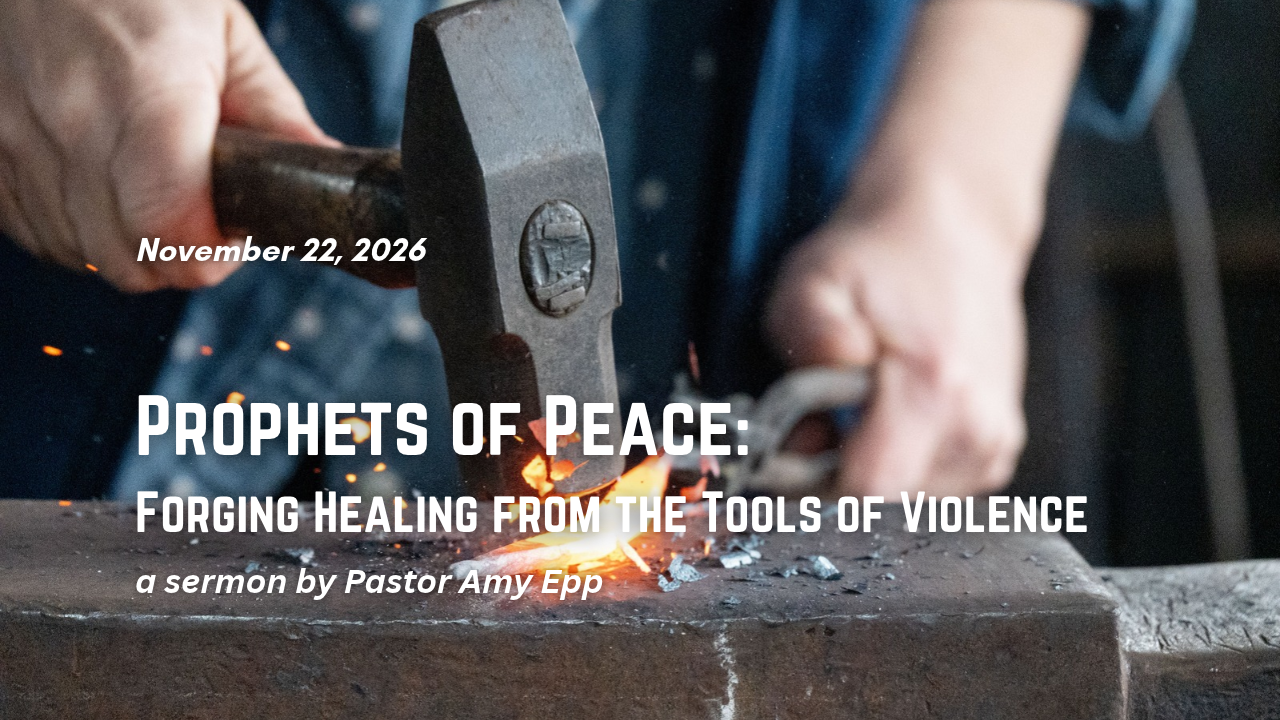
What is so beautiful about this vision, as I’m sure you also see, is the transformation of things that kill and destroy into tools that help to nurture and grow food. Tools that will truly aid the vine and fig tree and till the land.
RawTools is an organization that has taken the notion of repurposing weapons literally. Their website landing page takes up two prophet ideas and holds them front and center: “They will beat their swords into plowshares and their spears into pruning hooks. Nation will not take up sword against nation; they will train for war no more. Everyone will sit under their own vine and fig tree. No one shall make them afraid.”
RawTools does all kinds of non-violence interventions but their starting place was literally turning donated hand-guns into tools. Their ‘Guns to Gardens’ project does what the characters in Sparking Peace the picture book we read earlier in worship are doing – hammering weapons of violence into tools for growth.
You can go on their Colorado-based webstore right now and buy a little garden spade. The description says, “Made from various parts of former firearms, these garden spades have been riveted to a “dog leg” tang and into a handle made from wooden gun stock. Made for work or even a little display, these spades are ready to cultivate life!”
Cultivating life is what God’s prophets of peace will call us toward. Reminding God’s people that the vision of God is for the nations to be united, weapons transformed into tools for growth and nurture.
Almost immediately after Isaiah calls Hezekiah and the people of Jerusalem to trust in God and not to fear, the threat from Ravshakeh and the Assyrian army dissolves. The army leaves and meets their destruction elsewhere. But the threat isn’t gone forever. Jerusalem does end up facing violence and exile. The prophets continue to call on hope, on peace, and to name God’s constant presence.
There will always be leaders and false prophets who claim to act in God’s name. Who call us to violence or who do violence and say that God has sanctioned their actions. We are still living in a world full of turmoil and violence and threat. But the grounding image of nations who invest in nurture and growth, in good food rather than weapons, is the image that should center our action and reflection.
May we rise to Isaiah’s vision of peace, turning toward God and seeking out our own prophets who will ground us in that vision.
—